Feeds:
Posts
Comments

Quiet Lives

MEDITATION:

Written by Michael Wittmer, a contemporary ministry leader, pastor, and professor of theology. This is an excerpt from his  book “Heaven is a Place on Earth.”

Paul concludes his first letter to the Thessalonians by giving his readers something to shoot for in their Christian life. Paul commands these new believers “to lead a quiet life, to mind your own business and to work with your hands, just as we told you, so that your daily life may win the respect of outsiders and so that you will not be dependent on anybody.” Make it your ambition to lead a quiet life, earning a decent wage while tending to your vocations? How utterly ordinary! Paul, is that really all you expect from Spirit-filled believers? Pretty much. Paul confides to Titus that “our people must learn to devote themselves to doing what is good, in order that they may provide for daily necessities and not live unproductive lives.”  Why were such ordinary duties important to Paul? Because they alone made the gospel seem credible. Paul could preach all day long about the life-changing power of Christ, but he would convince few people without firsthand evidence that it really works. So he encouraged his followers to become good neighbors, responsible citizens who faithfully serve society by minding their callings and caring for the needs of others. No one and no job was too insignificant, for even slaves—the least influential people in Roman society—could still “make the teaching about God our Savior attractive” when they quietly and swiftly carried out their master’s orders. These common Christians apparently impressed their friends and family, for their new faith spread so swiftly through the empire that in just a couple of centuries it had conquered the entire Roman world. Come to think of it, maybe a community of normal Christians doing ordinary things for Christ can change the world. It happened once. It just might happen again.

PRAYER:

Written by John Greenleaf Whittier (1807-1892), an American Quaker poet and abolitionist.                                                                                                                      

Dear Lord and Father of humankind,

Forgive our foolish ways;

Reclothe us in our rightful mind.

In purer lives Thy service find,

In deeper reverence, praise.

Drop Thy still dews of quietness,

Till all our strivings cease;

Take from our souls the strain and stress,

And let our ordered lives confess

The beauty of Thy peace.

Breathe through the hearts of our desire

Thy coolness and Thy balm;

Let sense be dumb, let flesh retire;

Speak through the earthquake, wind, and fire.

O still, small voice of calm.

Worship

MEDITATION:

Written by Valerie Hess, a contemporary Christian author, speaker, and musician. This is an excerpt from her book “Spiritual Disciplines Devotional.”

When I teach about worship, I often ask the question, if corporate worship were likened to a football game, who represents the players, who represents the cheerleaders and who represents the fans? Many people see God in the role of the players and the congregation in the role of the fans, but that is a false view that can affect the way we worship.

In reality, God is in the stands watching us, the players on the field, worship. We are being cheered on, so to speak, by worship leaders. When we view ourselves as sitting in the stands watching, we may not be motivated to do our part. We may think we need to sit in the pew and watch while the pastor and the choir worship for us, or worse, entertain us. In truth, God is sitting in the pew watching as we worship. (This analogy is imperfect because God is also there in Word and Sacrament, hosting us in the Eucharist, inviting us closer to him in the Scripture readings; but for now we will focus on the other side of this worship reality.)

The root of the word liturgy means “the work of the people.” The liturgy is meant to be done by the people, not for the people. This concept destroys the notion that worship is to make me feel good. True worship of God may actually make us uncomfortable if we are honest.

PRAYER:

From the Daybreak Office of the Eastern Church, prayers said at dawn in the Byzantine Rite of the Eastern Orthodox Church                                                                                                                              

Lord God of our salvation,

we thank you

for all good things you do in our lives.

Help us always to look to you,

the Savior and Benefactor of our souls.

You have refreshed us in the past night,

raised us up from our beds,

and brought us to worship your glorious name.

Give us grace and power

that we may sing your praise with understanding,

pray to you without ceasing,

and continue to work out our salvation

with fear and trembling;

through the aid of your Christ. Amen.

Unity in Christ

MEDITATION:

Written by Max Lucado, a contemporary Christian pastor and author. This is an excerpt from his book “Outlive Your Life.”

The cross of Christ creates a new people, a people unhindered by skin color or family feud. A new citizenry, based not on common ancestry or geography, but on a common Savior. My friend Buckner Fanning experienced this firsthand. He was a marine in World War II, stationed in Nagasaki three weeks after the dropping of the atomic bomb. Can you imagine a young American soldier amid the rubble and wreckage of the demolished city? Radiation-burned victims wandering the streets. Atomic fallout showering on the city. Bodies burned to a casket black. Survivors shuffling through the streets, searching for family, food, and hope. The conquering soldier, feeling not victory but grief for the suffering around him.

Instead of anger and revenge, Buckner found an oasis of grace. While patrolling the narrow streets, he came upon a sign that bore the English phrase: Methodist Church. He noted the location and resolved to return the next Sunday morning. When he did, he entered a partially collapsed structure. Windows shattered. Walls buckled. The young marine stepped through the rubble, unsure how he would be received. Fifteen or so Japanese were setting up chairs and removing debris. When the uniformed American entered their midst, they stopped and turned. He knew only one word in Japanese. He heart it. Brother.” “They welcomed me as a friend,” Buckner relates, the power of the moment still resonating more than 60 years later. They offered him a seat. He opened his Bible and, not understanding the sermon, sat and observed. During communion the worshippers brought him the elements. In that quiet moment the enmity of their nations and the hurt of the war was set aside as on Christian served another the body and blood of Christ.

PRAYER:

Written by Max Lucado, author of today’s Meditation, and from the same book.                                                                                                                                            

Lord, in how many ways does my foolish heart make false distinctions among your people? Reveal them to me. How often do I judge someone as unworthy of you by the way I treat him or her? Rebuke me in your love. Where can I blast a wall or remove a barrier that keeps your children apart from one another? Give me some dynamite and the skill and courage to use it for your glory. What can I do in my sphere of influence to bring the love of Christ to someone who may feel ostracized or estranged from you? Lend me divine insight, and bless me with the resolve to be your hands and feet. May I be a bridge and not a wall. In Jesus’ name I pray. Amen.

Hope

MEDITATION:

Written by Barbara Johnson (1927-2007), an American Christian author. This is an excerpt from a book she co-authored, “Outrageous Joy.”

Someone once said, “There are no hopeless situations—only people who are hopeless about them.” Bonnie St. John Deane learned that truth firsthand in the 1984 Disabled Olympics. In the first run down the slalom course, she soundly beat her closest competitor, a skier from Austria. She confidently expected to finish first again on the second run and win the medal. Instead she fell on a patch of ice. Greatly disappointed, Bonnie halfheartedly stood up and finished the course. The Austrian won the gold medal—but not for skiing a flawless course. In fact, she too, slipped and fell. She won gold, “not for skiing faster but for getting up faster,” Bonnie wrote in her book, Succeeding Sane, “From that experience Bonnie learned that ‘winners aren’t people who never make mistakes. Winners are those who get up and finish. Gold-medal winners get up the fastest.’ ”

What a powerful analogy of the difference hope makes in our lives! Hope gives us a confident attitude that helps us get back up if we should fall. It injects us with a healthy dose of joy that assures us that no matter what happens to us on the course of life, we do not “grieve like the rest of men, who have no hope.” [1 Thessalonians 4:13].

PRAYER:

Written by Ambrose of Milan (339-397), a bishop of Milan who contributed to theology and doctrine of the early Christian Church and influenced Augustine of Hippo.

Merciful Lord,

Comforter and Teacher of your faithful people,

increase in your Church the desires you have given.

Strengthen the hearts of those who hope in you,

and show them the depth of your promises.

Lead all your adopted children to see with the eyes of faith,

and help them wait patiently  for the light that is now hidden;

through Jesus Christ our Lord.

Gentleness

MEDITATION:

Written by Jerry Bridges (1929-2016, an evangelical Christian author, speaker and staff member of The Navigators. This is an excerpt from his book “The Fruitful Life.”

Writing in 1839, George Bethune said, “Perhaps no grace is less prayed for, or less cultivated than gentleness. Indeed it is considered rather as belonging to natural disposition or external manners, than as a Christian virtue; and seldom do we reflect that not to be gentle is sin.” The Christian attitude toward gentleness does not seem to have changed in the more than 160 years since Bethune penned those words. I once asked a co-worker in our own ministry if he was aware of anyone who was praying for or seeking to cultivate gentleness. He thought for a moment and then said no. This is not to say that the grace of gentleness is entirely absent from the Christian community, but perhaps we don’t value it as highly as God values it.

Gentleness is somewhat difficult to define because it is often confused with meekness, which is another Christian virtue that we should pursue.  Billy Graham defines gentleness as “mildness in dealing with others…It displays a sensitive regard for others and is careful never to be unfeeling for the rights of others.” Gentleness is an active trait, describing the manner in which we should treat others. Meekness is a passive trait, describing the proper Christian response when others mistreat us. Both gentleness and meekness are born of power, not weakness. There is a pseudo-gentleness that is timidity, and there is a pseudo-meekness that is cowardly. But a Christian is to be gentle and meek because those are godlike virtues.

PRAYER:

Written by John Baillie (1886-1960), a Scottish theologian and a Church of Scotland minister.

This day O Lord —

Give me courtesy;

Give me both gentleness of demeanor and decisiveness of character;

Give me patience;

Give me love;

Give me self-control and faithfulness in my relationships;

Give me sincerity in my speech;

Give me diligence in the work you have given me to do.

O Lord, who when the time was right raised up our Lord and Savior Jesus Christ to enlighten our hearts with the knowledge of your love, grant me the grace to be worthy of his name. Amen.

Light Burden

MEDITATION:

Written by Dietrich Bonhoeffer (1906-1945), a Lutheran pastor, theologian, anti-Nazi dissident, author, and key founding member of the Confessing Church. This is an excerpt from the devotional, “40 Day Journey with Dietrich Bonhoeffer.”

Those who follow Jesus’ commandment entirely, who let Jesus’ yoke rest on them without resistance, will find the burden they must bear to be light. In the gentle pressure of this yoke they will receive the strength to walk the right path without becoming weary.…Where will the call to discipleship lead those who follow it? What decisions and painful separations will it entail? We must take this question to him who alone knows the answer. Only Jesus Christ, who bids us follow him, knows where the path will lead. But we know that it will be a path full of mercy beyond measure. Discipleship is joy.

To be a disciple is not just to believe in Jesus, it is to follow Jesus. Is your burden of discipleship “light”?

PRAYER:

Written by Basil the Great (330-379) of Caesarea, an influential theologian and pastor. He was one of the Cappadocian Fathers.

We bless You, O most high God and Lord of mercy, Who art ever doing numberless great and inscrutable things with us, glorious and wonderful; Who grants us sleep for rest from our infirmities, and repose from the burdens of our much toiling flesh. We thank You that You have not destroyed us with our sins, but has loved us as ever, and though we are sunk in despair, You have raised us up to glorify Your power.

Therefore we implore Your incomparable goodness, enlighten the eyes of our understanding and raise up our mind from the heavy sleep of indolence; open our mouth and fill it with Your praise, that we may be able undistracted to sing and confess You, Who art God glorified in all and by all, the eternal Father, with Your only-begotten Son, and Your all-holy and good and life-giving Spirit, now and ever, and to the ages of ages. Amen.

Forgiveness

MEDITATION:

Written by Pete Greig, a contemporary church planter, author and co-founder of the 24-7 Prayer Movement. This is an excerpt from his book “How to Pray.”

Corrie ten Boom’s family helped Dutch Jews escape the Nazi Holocaust during the Second World War. They were eventually caught, and Corrie was sent to Ravensbruck concentration camp with her sister Betsie, who later died there. Corrie endured unimaginable horrors, yet her life was marked by an unshakable trust in her heavenly Father and was punctuated by prayer. She seems to have lived in an almost continual conversation with God, asking and trusting in her heavenly Father for everything. “If a care is too small to be turned into a prayer,” she said, it is too small to be made into a burden.”

Several years after the war, Corrie ten Boom was speaking about her experiences in Munich, when one of her former S.S. guards approached her at the end of the church service. As Corrie ten Boom tells the story in her book The Hiding Place:  “How grateful I am for your message, Fraulein,” he said. “To think that, as you say, He has washed my sins away!” His hand was thrust out to shake mine. And I, who had preached so often…the need to forgive, kept my hand at my side. Even as the angry, vengeful thoughts boiled through me, I saw the sin of them. Jesus Christ had died for this man; was I going to ask for more? Lord Jesus, I prayed, forgive me and help me to forgive him. I tried to smile, I struggled to raise my hand. I could not. I felt nothing, not the slightest spark of warmth or charity. And so again I breathed a silent prayer. Jesus, I cannot forgive him. Give your forgiveness. As I took his hand the most incredible thing happened. From my shoulder along my arm and through my hand, a current seemed to pass from me to him, while into my heart sprang a love for this stranger that almost overwhelmed me. And so I discovered that it is not on our forgiveness any more than on our goodness that the world’s healing hinges, but on His. When He tells us to love our enemies, He gives, along with the command, the love itself. 

PRAYER:

Written by Cheryce Rampersad, a contemporary Christian author and blogger.

Father, bless me with the wonderful power of forgiveness, give me the grace to unconditionally forgive those who have done me wrong. Fill my heart with love toward my fellowman. Let kindness be my first nature. Let peace consume my thoughts and tranquility overtake my soul.  Free me of all anger, bitterness, hate, and unforgiveness.

Fruit

MEDITATION:

Adapted from a devotion written by Mark D. Roberts, a contemporary Christian speaker,  author, and principle writer of the “Life for Leaders” daily devotion from De Pree Center at Fuller Seminary.

When we moved into our home in Pasadena, we knew we had several citrus trees in the backyard. But we didn’t know exactly what kind of citrus trees they were. Finally, when the time was right, our trees bore their distinctive kind of fruit, and then we knew exactly what sorts of trees we had. (In case you’re curious, we have several lemon trees, one orange tree, and one tangerine tree, as well as a peach tree that showed up unannounced in our front yard.)

If you want to know what kind of tree you have, you need to pay attention to its fruit. The same is true if you want to know what kind of life you’re living. Are you living a good life? Then you’ll see it in your fruit. The opposite is true as well. Bad living is correlated with bad fruit. Fruit, in this case, is a way of talking about our behavior, about what we’re producing by being alive. So, this leads to an obvious question. What is your fruit? If you were to add up all that you’re doing in life – what you do for work, how you act in relationships, where you put your money, how you spend your time, and so on – what kind of fruit is growing on your tree?  If your family, friends, neighbors, and co-workers were to be given a dose of truth serum such that they had to tell the whole truth and nothing but the truth, how would they answer this question: What is the fruit of your life? What is your life producing? What difference are you making in this world? I believe that, for most of us, the fruit of our lives is a mixed bag. Some of our fruit is good; some is bad. We need to be honest about this. God will use our honesty to help us shift the balance in the favor of good fruit. Soon we’ll learn how this happens, according to Jesus.

PRAYER:

This prayer is based on Galatians 5:22 and is from the Daily Prayer Guide website. 

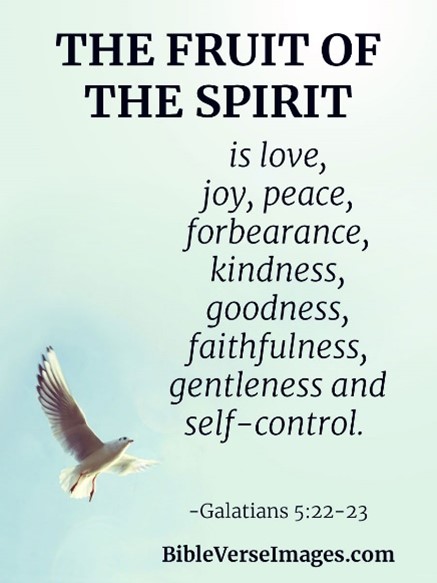
Father God, you are the giver of all good things. I pray to ask you to give me the fruits of the Spirit. Help me to love, be full of joy, peace, and patience. Help me be kind, good, faithful, and gentle when dealing with others. And finally, give me the self-control to bear the fruit so others can see. Amen.

Spiritual Transformation

MEDITATION:

Written by Henri Jozef Nouwen (1932-1996), a Dutch priest, professor, writer, and theologian. This is an excerpt from his book “Making All Things New.”

The spiritual life can be lived in as many ways as there are people. What is new is that we have moved from the many things to the kingdom of God. What is new is that we are set free from the compulsions of our world and have set our hearts on the only necessary thing. What is new is that we no longer experience the many things, people, and events as endless causes for worry, but begin to experience them as the rich variety of ways in which God makes his presence known for us. Indeed, having a spiritual life requires a change of heart, a conversion. Such a conversion may be marked by a sudden inner change, or it can take place through a long, quiet process of transformation. But it always involves an inner experience of oneness.

PRAYER:

This prayer is from The Liturgy of St. James, a form of liturgy used by some Eastern Christians of the Byzantine and West Syriac Rite. It is considered to be the oldest surviving liturgy developed for general use in the church from around the fourth century. 

O gracious King of ages, Master of all creation,

receive your Church that approaches you through Christ.

Give each of us what is good, bring us all to completeness

and make us ready by your sanctifying grace.

Unite us together in your Holy Church, which you purchased with the precious blood of your only Son, our Lord and Savior Jesus Christ; with him, and with your all-holy, good, and life-giving Spirit, you are blessed and glorified forever.

Salvation

MEDITATION:

Written by Evelyn Underhill (1875-1941), English Christian writer and pacifist.  This is from her book “The Spiritual Life.”

For a spiritual life is simply a life in which all that we do comes from the center, where we are anchored in God: a life soaked through and through by a sense of his reality and claim, and self-given to the great movement of his will.  Most of our conflicts and difficulties come from trying to deal with the spiritual and practical aspects of our life separately instead of realizing them as parts of one whole. If our practical life is centered on our own interests, cluttered up by possessions, distracted by ambitions, passions, wants and worries, beset by a sense of our own rights and importance, or anxieties for our own future, or longings for our own success, we need not expect that our spiritual life will be a contrast to all this. The soul’s house is not built on such a convenient plan; there are few soundproof partitions in it.

PRAYER:

Written by Thomas A Kempis (1380-1471), the author of “The Imitation of Christ”, one of the most popular and best known Christian books on devotion. 

God, our Father, we are exceedingly frail and indisposed to every virtuous and gallant undertaking. Strengthen our weakness, we beseech you, that we may do valiantly in this spiritual war; help us against our own negligence and cowardice, and defend us from the treachery of our unfaithful hearts. For Jesus Christ’s sake, Amen.