Written by Elizabeth Cooledge Jenkins, a contemporary writer and minister. This is an excerpt from the book “A Beautiful Year in the Bible.”
Many of us experience the temptation to compare our own paths to the paths of others. Seeing others thrive in their ministries, careers, or personal lives can make us feel as though our own achievements are not enough. Like Saul did with David, we often feel as though other people’s success threatens our own. Social media amplifies these feelings, cultivating a culture of competition and comparison…God’s callings often look vastly different for each of us. Recognizing the uniqueness of our callings can free us from our tendencies to compare and compete… No one’s calling is more important than anyone else’s…We find our callings by listening to God’s voice stirring within. We pay attention to the gifts God has given us; we look for creative ways to love God and others well and to sow seeds of peace and justice in our world…Our contributions are measured not by their visibility but by our faithfulness. We can serve joyfully, trusting in God’s wisdom and timing. Let us participate uniquely in God’s Kingdom work as our authentic selves.
Therefore do not be ashamed of the testimony about our Lord, nor of me his prisoner, but share in suffering for the gospel by the power of God, who saved us and called us to a holy calling, not because of our works but because of his own purpose and grace, which he gave us in Christ Jesus before the ages began [2 Timothy 1:8-9]
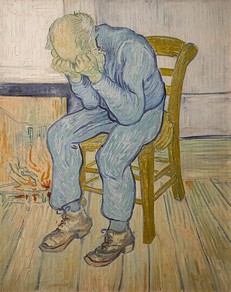
 Many don’t know that when Vincent van Gogh was a young man he served as a missionary among coal miners in Belgium. The experience left him with a deep admiration for the working poor. They did not understand deep theology, and most did not practice acceptable forms of piety, but they possessed God with a raw authenticity very different from the stiff religiosity van Gogh had known since his childhood. Vincent produced a charcoal drawing in 1882 that captures his esteem for the coal miners he served. It features an elderly man in a chair near a fire with his face buried in his hard, peasant hands. The reason for the man’s posture isn’t immediately clear. He could be crying or exhausted, but van Gogh revealed the truth with the drawing title—At Eternity’s Gate. It’s a portrait of a peasant in prayer. In a letter Vincent wrote, “This is far from theology, simply the fact that the poorest little woodcutter or peasant on the hearth or miner can have moments of emotion and inspiration which give him a feeling of an eternal home to which he is near. Van Gogh understood that powerful prayer is available to the ordinary, simple, and even the ignorant. It is for children and peasants, not just the pastors or the powerful. Sometimes we are impressed with those who pray with eloquence or who weave deep theology and Scripture into their petitions to God, and yet the prayer of an unschooled woodcutter asking his heavenly Father for his daily bread can possess the faith to bridge earth and eternity.