Feeds:
Posts
Comments

As Dallas Willard states in his book The Great Omission:  “Practicing the presence of God is the fundamental secret to directing and redirecting our minds constantly to Him.   In the early time of our practicing, we may well be challenged by our burdensome habits of dwelling on things less than God.  But these are habits that can be broken.  A new, grace-filled habit will replace the former ones as we take intentional steps toward keeping God before us.”

Thomas Watson (a Puritan from the 1600s) wrote:  “The first fruit of love is the musing of the mind upon God.  He who is in love, his thoughts are ever upon the object.  He who loves God is ravished and transported with the contemplation of God…God is the treasure, and where the treasure is, there is the heart.  By this we may test our love to God.  What are our thoughts most upon?  Can we say we are ravished with delight when we think on God?  …Do we contemplate Christ and glory? A sinner crowds God out of his thoughts.  He never thinks of God, unless with horror, as the prisoner thinks of the judge.”

Where do our thoughts take us throughout the day?  What disciplines can we put into practice that will help us make living in the presence of God a habit?  Share any practices you have found that helps you on this journey.  Success transforms our lives.

Psalm 16

The God Who Blesses You

Make sure you don’t forget God, your God, by not keeping his commandments, his rules and regulations that I command you today. Make sure that when you eat and are satisfied, build pleasant houses and settle in, see your herds and flocks flourish and more and more money come in, watch your standard of living going up and up—make sure you don’t become so full of yourself and your things that you forget God, your God,

the God who delivered you from Egyptian slavery;
the God who led you through that huge and fearsome wilderness,
those desolate, arid badlands crawling with fiery snakes and scorpions;
the God who gave you water gushing from hard rock;
the God who gave you manna to eat in the wilderness, something your ancestors had never heard of, in order to give you a taste of the hard life, to test you so that you would be prepared to live well in the days ahead of you.

 If you start thinking to yourselves, “I did all this. And all by myself. I’m rich. It’s all mine!”—well, think again. Remember that God, your God, gave you the strength to produce all this wealth so as to confirm the covenant that he promised to your ancestors—as it is today.  

— Deuteronomy 8:11-16 (The Message)

God Blesses

Glorify God

This devotional from Presbyterian Church Canada was very applicable to our WEBS study this week — God’s timing is impeccable!

What do we do when God answers our prayers? The story of Abraham’s chief servant finding a wife for Isaac has spoken deeply to my heart, as I also hope it will to yours. When he came to Abraham’s country, he prayed:

Genesis 24:12-14a – O Lord, God of my master Abraham, give me success today, and show kindness to my master Abraham. See, I am standing beside this spring, and the daughters of the townspeople are coming out to draw water. May it be that when I say to a girl, “Please let down your jar that I may have a drink,” and she says, “Drink, and I’ll water your camels too” — let her be the one you have chosen for your servant Isaac. (NIV)

God answered his prayer. But when the servant went to Rebekah’s home, what did do?

Genesis 24:33a – Then food was set before him, but he said, “I will not eat until I have told you what I have to say.” (NIV)

How many times have I prayed, and God has graciously answered, and yet I have kept from the world the part that God played in my success? How many times have you done the same? It is not that I do not give glory in my heart to Him for answered prayer. It is not that I do not give glory to Him amidst His people, for I do. Yet, when it comes to people of this world, such testimony is not always received well, and so, sometimes, and perhaps far too often, I have kept the most important part of the story to myself. I do not give the glory to God publicly for fear of offending others or making myself an object of ridicule. And yet, God has said through the apostle Paul:

Romans 10:13-14 – Everyone who calls on the name of the Lord will be saved. How, then, can they call on the one they have not believed in? And how can they believe in the one of whom they have not heard? And how can they hear without someone preaching to them? (NIV)

These verses are meant for all of us as God’s people. Many around us are entrapped in their sin and unbelief, and we hold the key to their freedom through the testimony which God has given to each of us through answered prayer. When we withhold the full story of our success from the world, we also withhold the key to their salvation and freedom in Christ. By telling our story in a quiet and respectful manner, however, we offer to all who listen the opportunity to know God better. Whether those who hear do accept the key we offer through our story is not the point. That choice belongs to them and them alone. The point is that we are to glorify God publicly so that others, indeed, may at least have the choice of salvation set before them. With God’s help, this is something that I am endeavouring to do more often. How about you?

glorify god

— Lynne Phipps (from PresbyCan Devotional)

Remembering God

Remembering is an important concept, mentioned throughout the Bible – in fact there are over 230 references in the Bible that deal with remembering.  The Bible speaks often of God’s faithfulness in remembering His promises to us, of our need to remember God and His promises, and warns us directly of the danger of forgetting the truth.   Remembering is intended as more than just a mental exercise.  Through remembering we are called to appropriate action in our lives and in our worship. What is it that God calls us to remember?

In Deuteronomy we are called to remember our requirements, as a child of God, to hear the Lord, love the Lord, instruct the family, and apply the word of the Lord to our lives.  We must also remember that all we have comes from God, that we own nothing on our own, and that we are here to take care of what belongs to God.

[Hear, O Israel: the Lord our God is one Lord [the only Lord]. And you shall love the Lord your God with all your [mind and] heart and with your entire being and with all your might.  And these words which I am commanding you this day shall be [first] in your [own] minds and hearts; [then] You shall whet and sharpen them so as to make them penetrate, and teachand impress them diligently upon the [minds and] hearts of your children, and shall talk of them when you sit in your house and when you walk by the way, and when you lie down and when you rise up. And you shall bind them as a sign upon your hand, and they shall be as frontlets (forehead bands) between your eyes. And you shall write them upon the doorposts of your house and on your gates. And when the Lord your God brings you into the land which He swore to your fathers, to Abraham, Isaac, and Jacob, to give you, with great and goodly cities which you did not build,  And houses full of all good things which you did not fill, and cisterns hewn out which you did not hew, and vineyards and olive trees which you did not plant, and when you eat and are full.  [Deuteronomy 6:4-11]]

We are also called to remember that our redemption and salvation is from God.   Jesus is the only one worthy to redeem us from our sins.  There is nothing we can do to earn our salvation – it is a gift given to us solely through God’s grace and our resulting faith in Him alone.  In him we have redemption through his blood, the forgiveness of sins, in accordance with the riches of God’s grace [Ephesians 1:7].

We are also called to remember the reward we receive for serving God.  God has promised good:  And you shall do what is right and good in the sight of the Lord, that it may go well with you and that you may go in and possess the good land which the Lord swore to give to your fathers [Deuteronomy 6:18].  Remembering the good work God has done in our lives serves as a reminder of the love He has brought us.  Our memories reveal His presence in our lives – even when we might have missed it at the time and attributed something to our own works or happenstance.  If we remember we can begin to better rely on God now and in the future.   We can serve as a testament to His power and glory.

In our busy lives, don’t forget to remember!  Give thanks that God has brought you to this day.

fb-god-wants-you-to-remember

Celebrate God

Philippians 4:4-9The Message (MSG)

Celebrate God all day, every day. I mean, revel in him! Make it as clear as you can to all you meet that you’re on their side, working with them and not against them. Help them see that the Master is about to arrive. He could show up any minute!

Don’t fret or worry. Instead of worrying, pray. Let petitions and praises shape your worries into prayers, letting God know your concerns. Before you know it, a sense of God’s wholeness, everything coming together for good, will come and settle you down. It’s wonderful what happens when Christ displaces worry at the center of your life.

Summing it all up, friends, I’d say you’ll do best by filling your minds and meditating on things true, noble, reputable, authentic, compelling, gracious—the best, not the worst; the beautiful, not the ugly; things to praise, not things to curse. Put into practice what you learned from me, what you heard and saw and realized. Do that, and God, who makes everything work together, will work you into his most excellent harmonies.2corinthians5-17

Our Faithful God

Your love, Lord, reaches to the heavens, your faithfulness to the skies. Your righteousness is like the highest mountains, your justice like the great deep. You, Lord, preserve both people and animals.  How priceless is your unfailing love, O God! People take refuge in the shadow of your wings.   They feast on the abundance of your house; you give them drink from your river of delights. For with you is the fountain of life; in your light we see light.  – Psalm 36:5-9

God is faithful

The world is full of problems; we see the evil of the world played out on the daily news and sometimes it touches us very directly.  But, the Bible teaches us repeatedly that God is faithful and steadfast in His love for us. He is an ever present force of good in the world – a good that is ultimately greater than the evil.  The Westminster Larger Catechism reminds us that:  “God is infinite in being, glory, blessedness and perfection:  all-sufficient, eternal, unchangeable, incomprehensible, everywhere present, almighty: knowing all things, most wise, most holy, most just, most merciful and gracious, longsuffering and abundant in goodness and truth.”

The ungodly people of the world do not acknowledge that God is all powerful and instead try to be sustained only by their own power and authority. The evil of the world can overpower them as they are ill equipped to deal with it. The godly, however, have much reason to have hope because they can see the Spirit of God at work in the world; they can remember His involvement in moments of their lives;  they can place their faith in God’s promises for goodness and righteousness and equity; they can have faith in the promise that God will ultimately triumph over evil.

Let’s praise a faithful God who provides His light to the darkness of the world – “the light shines in the darkness, and the darkness has not overcome it” [John 1:5].

Prayer of Apollonius

Apollonius (2nd century AD)  was an illustrious Roman, perhaps a senator, and an exceedingly talented man, well versed in philosophy. He was denounced as a Christian. According to Saint Jerome, when he was summoned to defend himself, he read to the senate, “a remarkable volume” in which, instead of recanting, he defended the Christian faith. As a result, he was condemned to death on the basis of the law established by the Emperor Trajan.  Apollonius was not afraid to die, because, he said: “There is waiting for me something better: eternal life, given to the person who has lived well on earth.” And he argued for the superiority of Christianity’s concepts of death and life.

A prayer attributed to him is as relevant today as in his own day:

“O Lord Jesus Christ, give us a measure of your Spirit that we may be enabled to obey your teaching:  to pacify anger, to take part in pity, to moderate desire, to increase love, to put away sorrow, to cast away vain glory, not to be vindictive, not to fear death; ever entrusting our spirit to the immortal God who with you and the Holy Spirit lives and reigns world without end.”

Apollonius

Do Not Forget the Lord

We are called to follow Jesus on a daily basis – to make God the center of our life and the center of our thoughts and deeds and to love one another.  “‘Love the Lord your God with all your heart and with all your soul and with all your mind.’  This is the first and greatest commandment. And the second is like it: ‘Love your neighbor as yourself.’ [Matthew 22: 37-39]  These commandments, when lived out, are transformational.  We are called to a new life based on the gracious and undeserved love God has for us.  We are humbled and acknowledge that we have standing before God based on God’s grace alone and not based on anything of ourselves.   Because of God’s gracious love to us, we are compelled to reflect that love to others.

Our “new life” as Christians does not relieve us from our problems, however.  As humans, we are naturally prideful and sinful.   We can get distracted by the challenges life brings – the extreme busyness of life, hurts and disappointments from those we trust and love, health issues, and problems we encounter that are sometimes difficult to comprehend, let alone solve.  We can easily lose our focus on God.  When we weaken this relationship,  the problems of life can cause anxiety, stress, and confusion.  We may begin to make God a lower priority or perhaps even engage in open rebellion against Him.

It is important that we are disciplined in maintaining our relationship with God.  We need to engage in daily conversation with Him through prayer; find time for silent contemplation to hear Him; engage in Bible study to better understand the nature of the God we love.  As we mature in our relationship with Him, we will be able to recall God’s faithfulness and love and feel His continued presence in our lives.  Bad days, when handled in obedience alongside a loving God, can humble us, renew our faith and we can continue to try to live a life that is both pleasing to God and helpful to others.  We are only prepared to do that when we remember all He has done for us.  As you worship God today, thank Him for his everlasting and ever present grace and faithfulness.  Pray that He will be the focus of your life today.

love-God

Give Generously

Each of us has unique gifts and we need to think about how we can generously share these gifts. Some people have talents, others have time, some have money. Whatever gifts we have been given we will find the most satisfaction in our own lives if we figure out how to use our gifts to make the world a better place for someone else. Sometimes we need to be generous to those who are closest to us — our family and close friends. Other times we need to reach beyond our close acquaintances and serve our local community, our regional community, or even our world community.

We should give not be to bring ourselves recognition. Rather, our generous giving needs to be done to bring glory to God, thanking Him for the gifts we have received, with the intent to love our neighbor as ourselves.

“Be careful not to do your ‘acts of righteousness’ before men, to be seen by them. If you do, you will have no reward from your Father in heaven. “So when you give to the needy, do not announce it with trumpets, as the hypocrites do in the synagogues and on the streets, to be honored by men. I tell you the truth, they have received their reward in full. (NIV, Matthew 6:1-2)

Matthew-6.1

Be imitators of God, therefore, as dearly loved children and live a life of love, just as Christ loved us and gave himself up for us as a fragrant offering and sacrifice to God [Ephesians 5:1-2]

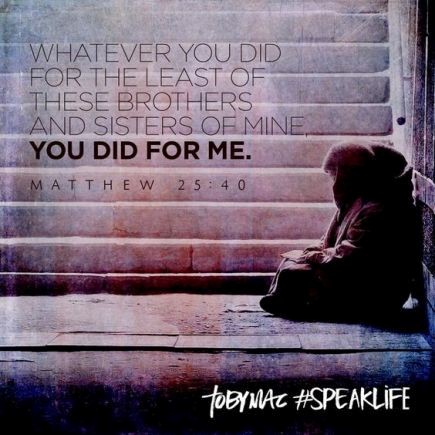
Live a life of love … a seemingly simple command in the Bible that will better our lives and glorify God.  What happens when we decide to glorify God in our daily lives by demonstrating love to all around us?  If we begin the day thinking about good we things can do for our family, our friends, our neighbors, or those we casually encounter, we start to focus our attention away from ourselves and to others.  When we take the time to think of ways to lift up others, and less about what others can do for us, we allow our egos to step aside.  If we start to think of others the way Jesus would think of them, we can live our lives in a way that brings glory and honor to God, and positively influences the lives of those we encounter. We can begin to live the life that God would have us live.

So start concentrating on how we can be more loving.  While getting ready to start the day, come up with three special things you will do for someone that day that is a reflection of a caring and loving heart.  Strike up a conversation with someone who is thought of as an “outcast” in the neighborhood, work or school.  Offer praise to your child for something you catch them doing that is good.  Give a hug to someone who is going through some pain.  At the end of the day, reflect on how these acts of kindness and love demonstrate the way that Jesus would react to those in his circle of life.  Offer a prayer that you will touch more lives each day and that your behavior will be a living witness to the loving hand of God to those around you.   Each morning think of ways that you can be the hands and feed of Jesus — find ways to treat others in the way that Jesus would treat them if he were standing in your shoes.

As we practice the discipline of kindness, we will find ways to help others at all turns — not just those we pre-plan.  Our lives will be transformed as we focus our attention on the needs of others.  Our actions will be a fragrant offering and sacrifice to God.

February 27, 2011