Feeds:
Posts
Comments

Who is Righteous Like God?

MEDITATION:

Written by Lori Austin, a contemporary Christian author.

The answer to that question, who is righteous like God, is an easy one. No one. The fact that God is righteous means that He will always do what is morally right. He has not only created a law to rule the universe, but He is also able to perfectly follow it. Righteousness can be understood as living up to the standard set by God’s own person and nature.  God’s law contained in the Bible is an expression of His righteousness. None of us can live up to God’s standard of righteousness. Even Abraham, who is often considered the father of our faith, fell short. We know that Abraham lied on more than one occasion and did not always follow God perfectly. Yet in several places, the Bible says that Abraham believed God and it was credited to him as righteousness. We cannot hope to be morally perfect enough to earn righteousness, but if we believe God, He credits us with righteousness. J.A. Ziesler says, “Imputing the righteousness of Christ to the believer is not an actual infusing of holiness into the individual. It is a matter of declaring the person righteous, as a judge does in acquitting the accused.”  In this, God still maintains His perfect righteousness. The same word translated “righteous” is sometimes translated “justice,” showing that these two concepts are intertwined. God does not negate his justice by giving us a free pass on breaking His standards. Instead, He pays the price for us, therefore adhering to His law but still showing us mercy by paying the price for our sin. As Romans 4:5 states, “And to the one who does not work but believes in Him who justifies the ungodly, his faith is counted as righteousness.”

PRAYER:

From the Roman Breviary, the book of Latin liturgical rites of the Catholic Church. Published in 1482, it became known as the Liturgy of the Hours.

O Lord God,

King of heaven and earth,

order and hallow,

rule and govern,

our hearts and our bodies,

our thoughts,

our works,

and our words,

according to your commandments,

that with your help,

we may be delivered and saved,

now and forever;

through Jesus Christ our Lord. Amen

God Provides

MEDITATION:

Written by Billy Graham (1918-2018), an American evangelist and minister.

Man hungers for food, and God sends the sun and rain upon the golden fields of grain. The grain is made into flour, and flour into bread, and man’s physical hunger is satisfied. Man hungers for love; and God ignites the fire of affection in another heart, and two hearts are made complete in the bonds of holy matrimony.

Man hungers for knowledge, and God raises up institutions of learning, calls men to be instructors, puts it into the hearts of the rich to endow them; and men are satisfied in their thirst for knowledge. Man hungers for fellowship; and God allows him to build cities where men can share their industry, and their knowledge, and their skills.

Don’t tell me that God can supply man with an abundance of everything material and yet will let him starve spiritually! . . . God will satisfy the hunger and thirst of those who desire His righteousness because He loves the world with an undying affection.

PRAYER:

Written by John Baillie (1886-1960) was a Scottish theologian and  a Church of Scotland minister.

For the power You have given me to lay hold of things unseen; For the strong sense I have that this is not my home; For my restless heart which nothing finite can satisfy, I give You thanks, O God. For the invasion of my soul by Your Holy Spirit; For all human love and goodness that speaks to me of You; For the fullness of Your glory outpoured in Jesus Christ; I give You thanks O God. Amen.

Morality and Righteousness

MEDITATION:

Written by Tim Challies, a contemporary Christian author.

First and foremost, righteousness is an attribute of God. The fact that God is righteous means that he “always acts in accordance with what is right and is himself the final standard of what is right” (Wayne Grudem). Righteousness is a statement about God’s moral nature and it means that he never does wrong. More than that, God’s righteousness means that he cannot do wrong.

For man, righteousness is a measure of morality just as it is for God, but man has no part in defining what is right. Man is righteous only as much as his morality, expressed in desires, thoughts, and deeds, conforms to that of God’s. Where he differs with God, he is unrighteous. Scripture is clear that because Adam’s sin has corrupted every man, “none is righteous, no, not one” (Romans 3:10; cf. Psalm 14:1-3). But it is also clear that Jesus Christ lived a perfectly righteous life and died for our sins in order to free us from our punishment and credit us with his own righteousness–the righteousness of God. This is the gospel.

PRAYER:

Written by Clement of Alexandria (150-215), a Christian theologian and philosopher.

O Educator, be gracious to your children, O Educator, Father, Guide of Israel, Son and Father, both one, Lord. Give to us, who follow your command, to fulfill the likeness of your image, and to see, according to our strength, the God who is both a good God and a Judge who is not harsh. Bestow all things on us who dwell in your peace, who have been placed in your city, who sail the sea of sin unruffled, that we may be made tranquil and supported by the Holy Spirit, the unutterable Wisdom, by night and day, unto the perfect day, to sing eternal thanksgiving to the one only Father and Son, Son and Father, Educator and Teacher with the Holy Spirit. Amen.

Christ’s Obedience

MEDITATION:

Written by Andrew Murray (1828-1917), a South African writer, teacher, and pastor.

“Through the obedience of the One shall the many be made righteous.” These words tell us what we owe to Christ. As in Adam, we were made sinners, in Christ we are made righteous. The words tell us, too, to what in Christ it is we owe our righteousness. As Adam’s disobedience made us sinners, the obedience of Christ makes us righteous. To the obedience of Christ we owe everything. Among the treasures of our inheritance in Christ this is one of the richest…You are familiar with the blessed truth of justification by faith…The object of Christ’s life of obedience was threefold: 1) As an example, to show us what true obedience was. 2) As our surety, by His obedience to fulfill all righteousness for us. 3) As our Head, to prepare a new and obedient nature to impart to us. So He died, too, to show us that His obedience means a readiness to obey to the uttermost, to die for God; that it means the vicarious endurance and atonement of the guilt of our disobedience; that it means a death to sin as an entrance to the life of God for Him and for us.

PRAYER:

Written by Paul H. Ashby, a contemporary English author, chaplain, and minister.

Your salvation, Lord God, may be beyond our full comprehension, but it is real and true. So we praise You for Your glorious love and for making it real through the life, death, and resurrection of Jesus Christ! May we seek to know as much about this as possible; but more than that, may we receive its truth and live by it, throughout our lives: AMEN.

Right In Our Own Eyes

MEDITATION:

Written by Philip Wijaya, contemporary Christian student and author. This is an excerpt from his work “What is Righteousness?”

As we live in a world where people tend to believe that their ways are right in their own eyes, we find it is hard for many to accept the absolute standard of righteousness. True or false becomes relative, and many believe they can do whatever they think or feel is right…Righteousness, in human standards, is defined as “the quality of being morally true or justifiable.” The justification is made according to the conformity of behavior with the regulation (or constitution, in the context of a nation). In its deeper spiritual meaning, righteousness is the quality of being right in the eyes of God, including character (nature), conscience (attitude), conduct (action), and command (word). Righteousness is, therefore, based upon God’s standard because He is the ultimate Lawgiver …  Righteousness is a God-centered attribute: no man can attain it through his own efforts apart from His ordinance. We, humans, are inclined to follow our own paths and use our own ways, instead of God’s. (Notice that this selfish desire for independence from God is in our nature, we need nobody to teach us that, but we always need the discipline to remain faithful in the path of God). Righteousness is not being legalistic — it is not about our achievements in “God’s school of law.” Righteousness is a wonderful gift from God to humanity through Christ’s act of love… In Christ, we are forever loved by God unconditionally. We are accepted and justified not by our own goodness but by the perfect love of God. This grace and mercy of God does not mean a license to sin (of course!). Having been so tremendously loved by the Heavenly Father, we are to express our gratefulness by continuously living in His righteousness. To God be the glory! 

PRAYER:

From the Sarum Primer, a book of prayers and Christian worship resources from the 1500s, collected at the Salisbury Cathedral.

Almighty God,

fountain of eternal light,

send forth your truth into our hearts,

and pour on us the glory of your brightness;

through Jesus Christ our Lord. Amen.

MEDITATION:

Written by InTouch Ministries, founded by Dr. Charles Stanley.

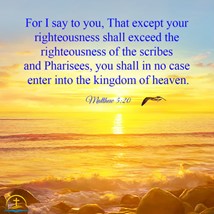
In the Sermon on the Mount, Jesus made a statement His listeners probably found shocking—He said they wouldn’t enter the kingdom of heaven unless their righteousness surpassed that of the scribes and Pharisees. The Pharisees were considered the definition of righteous: They were the religious elite, who often elevated their own self-worth and standing in the community. Frankly, the righteousness they projected would have seemed tough to surpass. Thankfully, Jesus wasn’t saying to beat them at their own game; He was pointing to a different standard altogether. Godliness isn’t attained by pursuing perfection, dressing a certain way, or by holding positions of influence in society. Rather, we become righteous by making oneness with God the focus and substance of our daily life and boasting only in Him. (See 1 Corinthians 1:18-31).

PRAYER:

Written by Oscar Romero (1917-1980). the 4th archbishop of San Salvador. He spoke out against poverty, social injustice, assassinations, and torture.

It helps, now and then, to step back, and take the long view. The Kingdom of Heaven is not only beyond our efforts, it is even beyond our vision. We accomplish in our lifetime only a tiny fraction of the magnificent enterprise that is God’s work. Nothing we do is complete, which is another way of saying that the Kingdom always lies beyond us. No statement says all that could be said. No prayer fully expresses our faith. No confession brings perfection. No pastoral visit brings wholeness. No program accomplishes the Church’s mission. No set of goals and objectives includes everything. This is what we are about. We will plant the seeds that one day will grow, We water seeds already planted knowing that they hold future promise. We lay foundations that will need further development. We provide yeast that produces effects far beyond our capabilities. We cannot do everything, and there is a sense of liberation in realizing that. This enables us to do something, and to do it very well. It may be incomplete, but everything is a beginning, a step along the way, an opportunity for the Lord’s grace to enter and do the rest. We may never see the end results, but that is the difference between the master builder and the worker. We are the workers, not master builders, ministers, not messiahs. We are prophets of a future of our own. May that future be filled with grace, peace, and hope. Amen.

Self Righteousness

MEDITATION:

Written by Amy Carroll, a contemporary Christian author. This is an excerpt from her devotion “Being Right Doesn’t Mean I’m Righteous.”

God is filling me with a simple prayer: Lord, please make me completely righteous and not a bit self-righteous. The word righteous means, “acting in accord with divine and moral law, free from guilt or sin” according to Webster. But being righteous and looking righteous are two different things. Looking righteous is something I’ve mastered. I know how to follow the rules, play the game and fit into the church crowd. Maybe you’re like me and are wired to work hard to get things done “right.” I like to please my peers and check items off my to-do list. Often it wins me the approval I crave. I get pats on the back, and it all looks good on the outside. But on the inside — in the quiet moments — I can find myself exhausted. Defeated. Numb. Those feelings let me know I’ve crossed from being righteous through Christ into trying to earn righteousness myself. Sometimes my self-righteousness leaks out and reveals its ugliness through judgmental thoughts and attitudes towards others. That’s when I find myself looking down my nose at those struggling while thinking I have it together or snapping with impatience when someone delays my next task. … To maintain the right heart, God asks us to keep returning to our first love with Him. To rediscover the newness, lightness and joy we felt at first. He urges us to constantly rekindle passion for Him, which will deepen our love for Him and others. The beautiful part is God doesn’t call us to love without Him setting the ultimate example. His love is “wide and long and high and deep” (Ephesians 3:18, NIV), and it surpasses our thoughts and the works done in our own strength. Pursuing righteousness solely through good works is an empty endeavor, always leaving us impossibly short of the goal. Returning to our first love ensures full righteousness as we follow Jesus, for He is our righteousness… True righteousness creates more love for God and others. It’s a beautiful cycle, and it’s a goal that transforms us.

PRAYER:

John Chrysostom (AD 347-407), theologian and archbishop of Constantinople.

O my all-merciful God and Lord, Jesus Christ, full of pity: through Your great love You came down and became incarnate in order to save everyone. O Savior, I ask You to save me by Your grace! If You save anyone because of their works, that would not be grace but only reward of duty, but You are compassionate and full of mercy! You said, O my Christ, “Whoever believes in Me shall live and never die.” If then, faith in You saves the lost, then save me, O my God and Creator, for I believe. Let faith and not my unworthy works be counted to me, O my God, for You will find no works which could account me righteous. O Lord, from now on let me love You as intensely as I have loved sin, and work for You as hard as I once worked for the evil one. I promise that I will work to do Your will, my Lord and God, Jesus Christ, all the days of my life and forevermore.

Armor of God

MEDITATION:

Written by Ray Stedman (1917-1992), an evangelical Christian pastor and author. This reflection is an excerpt from his devotional “The Breastplate of Righteousness.”

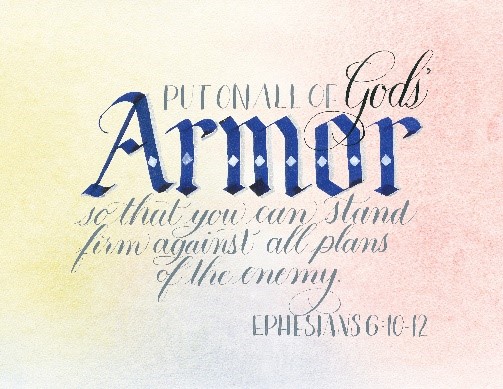
Christ is the ground of your righteous standing before God, your acceptance before Him. If you are wearing that breastplate, you can rest secure that your heart, your emotions, are securely guarded and adequately protected against attack. Christians often feel they lack assurance. They feel unworthy of God. They feel they are a failure in the Christian life and that God is certain to reject them, that He is no longer interested in them. They are so aware of their failures and shortcomings. Growth has been so slow. The first joy of faith has faded, and they feel God is angry with them or that He is far off somewhere. There is a constant sense of guilt. Their conscience is always stabbing them, making them unhappy. They feel God blames them. This is simply a satanic attack.  How do you answer an attack like this? You are to remember that you have put on the breastplate of righteousness. In other words, you do not stand on your own merits. You never did. You never had anything worthwhile in yourself to offer to God. You gave all that up when you came to Christ. You quit trying to be good enough to please God. You came on His merits. You came on the ground of His imputed righteousness—that which He gives to you. You began your Christian life like that, and there is no change now. You are still standing before God on that basis. What a ground for discouragement! How easy it would have been for the apostle Paul to say to himself, What’s the use? Here I am working my fingers to the bone, making tents and trying to preach the gospel to these people and look at the blessing God has brought them, but they don’t care. They hurl recriminations back into my face. Why try anymore? But that is not what he does. Instead, he says, But by the grace of God I am what I am, and his grace toward me was not without effect (1 Corinthians 15: l0a). There he is using the breastplate of righteousness. I don’t care, he says, what I have been; I don’t defend what I am. I simply say to you, by the grace of God, I am what I am. What I am is what Christ has made me. I’m not standing on my righteousness; I’m standing on His. I am accepted by grace, and my personal situation does not make any difference at all. So his heart was kept from discouragement.

PRAYER:

From the Leonine Sacramentary, the earliest surviving collection of Roman Mass formularies and ordination prayers from the early 7th century.

O Lord,

help us always

to seek your kingdom and righteousness.

Give us all other things we need as well;

through Jesus Christ our Lord.

Letting Go

MEDITATION:

Written by John Van Schepen, a contemporary retired pastor and author.  

Children, what would you say if I asked you to throw your most treasured toy into the garbage? Young people, as you look to the future, imagine being asked to forget about one of your main goals, such as marriage or a college education. And what about the things you have right now? Is your most prized possession a car? A career? Your stock portfolio? Could you consider them rubbish right now? Really?

Paul was one of the most successful young men in his community. He had the right credentials by birth, learning, and life experience. Yet he was willing to consider it all rubbish. Why? Certainly not for an easier life or for fame and glory. He knew that letting go was the only way to receive God’s gift of righteousness through faith in Christ.

Are you holding on to something that is preventing you from stretching out your hand to receive God’s gift of righteousness by faith? This gift includes the forgiveness of sins, a new life of service to the Lord, and eternal life. Everything you have or might like to have pales in comparison to the gift of God’s righteousness through faith in Christ. Receive him as Lord, and the gift of his righteousness will be yours.

PRAYER:

Written by William Barclay (1907-1978), a Scottish author, radio and television presenter, professor of Divinity, and minister in the Church of Scotland.

Grant, O God, that we may never lose the way through our self-will, and so end up in the far countries of the soul; that we may never abandon the struggle, but that we may endure to the end, and so be saved; that we may never drop out of the race, but that we may ever press forward to the goal of our high calling; that we may never choose the cheap and passing things, and let go the precious things that last forever. that we may never take the easy way, and so leave the right way; that we may never forget that sweat is the price of all things, and that without the cross, there cannot be the crown. Amen.

God’s Perfection

MEDITATION:

Written by Erwin Lutzer, a contemporary pastor, teacher, and author.   This reflection is excerpted from his writing “The Gospel of Righteousness.”

The question before us, the question that goes to the heart of what we call the Gospel, is: How do we become as perfect as God? The great reformer Martin Luther grappled with the same question: How can a sinner receive the favor of a holy God who is just and hates sin? … To understand the Gospel, let’s begin by considering the phrase the righteousness of God, which troubled Luther greatly. If God were not so righteous, we would have a better chance to win His favor, but it is His righteousness that stands as a barrier between us and Him.

We can all identify with Luther’s dilemma. If God were not so holy—if He were more like us—then we might be able to meet His requirements. But the Bible, and even our own conscience, tells us that we are sinners, and we can’t reach the high standard of God’s righteousness by our own efforts. But Luther learned, as we must, that righteousness is not just an attribute of God, but there is also a “righteousness from God,” which is a gift given to those who believe on Christ. To put it plainly, in Christ God meets His own requirements for us. We have no righteousness of our own, so God gives us His own righteousness as a free gift. In other words, God demands righteousness, and through the death and resurrection of Christ, God supplies the righteousness that He demands! The blood of Christ covers our sins so that we can come into the presence of God. And when it is time for us to die, we are welcomed into Heaven as if we were Jesus because we are saved solely on the perfections of His merit and grace.

PRAYER:

Written by Anselm of Canterbury (1033-1109), a Benedictine monk, abbot, philosopher and Christian theologian. He served as the archbishop of Canterbury from 1093-1109.

O Lord Jesus Christ, our redemption and our salvation, we praise you and give you thanks. Though we are unworthy of your benefits,  and cannot offer to you the devotion you deserve,  let your loving-kindness complete whatever our weakness tries to do.

Before you, O Lord, we lay all our desires, and whatever our heart rightly wishes, it is because of your gift. Help us love you as you command. Do not let your gift be unfruitful in us. Complete what you have begun, give what you have made us desire, convert our lukewarmness into fervent love of you; for the glory of your holy name. Amen.