Feeds:
Posts
Comments

God’s Commands

MEDITATION:

Written by Oswald Chambers (1874-1917), a Scottish evangelist and teacher.  This is an excerpt from his book “My Utmost for His Highest.”

God’s commands to us are actually given to the life of His Son in us. Consequently, to our human nature in which God’s Son has been formed, His commands are difficult. But they become divinely easy once we obey. Conscience is that ability within me that attaches itself to the highest standard I know, and then continually reminds me of what that standard demands that I do. It is the eye of the soul which looks out either toward God or toward what we regard as the highest standard. This explains why conscience is different in different people. If I am in the habit of continually holding God’s standard in front of me, my conscience will always direct me to God’s perfect law and indicate what I should do. The question is, will I obey? I have to make an effort to keep my conscience so sensitive that I can live without any offense toward anyone. I should be living in such perfect harmony with God’s Son that the spirit of my mind is being renewed through every circumstance of life, and that I may be able to quickly “prove what is that good and acceptable and perfect will of God.”

God always instructs us down to the last detail. Is my ear sensitive enough to hear even the softest whisper of the Spirit, so that I know what I should do? “Do not grieve the Holy Spirit of God…” . He does not speak with a voice like thunder— His voice is so gentle that it is easy for us to ignore. And the only thing that keeps our conscience sensitive to Him is the habit of being open to God on the inside. When you begin to debate, stop immediately. Don’t ask, “Why can’t I do this?” You are on the wrong track. There is no debating possible once your conscience speaks. Whatever it is— drop it, and see that you keep your inner vision clear.

PRAYER:

Written by Clemant of Rome (c35 A.D. – 99), the fourth bishop of Rome.

We ask, with prayer and supplication, that the Creator of the universe may guard intact to the end the number of his elect throughout the whole world, through his beloved Son Jesus Christ, through whom he called us from darkness to light, from ignorance to the full knowledge of the glory of his name. Grant to us, Lord, that we may set our hope on your name which is the primal source of all creation, and open the eyes of our hearts, that we may know you, who alone dwells in the highest heavens, holy in the holy, who lays low the insolence of the proud, who sets the lowly on high, and brings the lofty low, who makes rich and makes poor, who kills and makes alive, who alone is the Benefactor of spirits and the God of all flesh, who looks into the abyss, who scans the works of man, the provider of those who are in peril, the Savior of those who are in despair, the Creator and Overseer of every spirit, who multiplies the nations on earth, and has chosen out from all men those that love you through Jesus Christ, your beloved Son, through whom you instructed us, sanctified us, and honored us. Amen.


MEDITATION:

Written by Thomas a Kempis (1380-1471), a German-Dutch priest and author of one of the most popular and best known Christian devotional book, “The Imitation of Christ” of which this is an excerpt.

Lord, you know what is most profitable to me; do this or that according to your will. Give me what You will, as much as You will, and when You will. Do with me as You know what is best to be done, as it shall please You, and as it shall be most to Your honor. Put me where You will. I am Your creature, and in Your hands; lead me and turn me where You will. Lo, I am Your servant, ready to do all things that You command, for I do not desire to live to myself, but to You. Would to God that I might live worthily and profitably, and to Your honor.

PRAYER:

An ancient lychnapsia (lamp lighting) prayer, once said by the Orthodox priest silently.

O Lord, compassionate and merciful, long-suffering and plentiful in mercy, attend to the voice of our prayer. Work upon us a sign for the good. Lead us in your way, that we may walk in the truth. Gladden our hearts that we may honor your holy name. For you are great and work wonders. You alone are God and among all the powers there is none like you, our Lord, who is might in mercy, gracious in strength, always ready to aid and to comfort and save those who put their trust in your holy name. And to you are due all glory, honor, and worship. Now and ever to the ages of ages. Amen.

Open Hearted

MEDITATION:

Written by Charles Spurgeon (1834-1892), an English Baptist preacher, known as the “Prince of Preachers.”

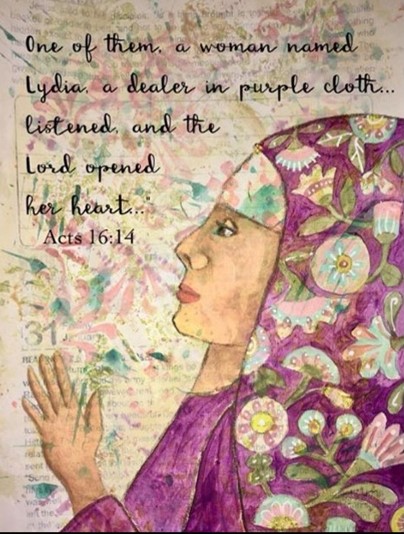
In Lydia’s conversion there are many points of interest. It was brought about by providential circumstances. She was a seller of purple, of the city of Thyatira, but just at the right time for hearing Paul we find her at Philippi; providence, which is the handmaid of grace, led her to the right spot. Again, grace was preparing her soul for the blessing–grace preparing for grace. She did not know the Savior, but as a Jewess, she knew many truths which were excellent stepping-stones to a knowledge of Jesus. Her conversion took place in the use of the means. On the Sabbath she went when prayer was wont to be made, and there, prayer was heard. Never neglect the means of grace; God may bless us when we are not in his house, but we have the greater reason to hope that he will when we are in communion with his saints. Observe the words, “Whose heart the Lord opened.” She did not open her own heart. Her prayers did not do it; Paul did not do it. The Lord himself must open the heart, to receive the things which make for our peace. He alone can put the key into the hole of the door and open it and get admittance for himself. He is the heart’s master as he is the heart’s maker. The first outward evidence of the opened heart was obedience. As soon as Lydia had believed in Jesus, she was baptized. It is a sweet sign of a humble and broken heart, when the child of God is willing to obey a command which is not essential to his salvation, which is not forced upon him by a selfish fear of condemnation but is a simple act of obedience and of communion with his Master. The next evidence was love, manifesting itself in acts of grateful kindness to the apostles. Love to the saints has ever been a mark of the true convert. Those who do nothing for Christ or his church, give but sorry evidence of an “opened” heart. Lord, evermore give me an opened heart.

PRAYER:

Written by Augustine of Hippo (354-430), an early Christian theologian and philosopher. He was the bishop of Hippo Regius (modern day Annaba, Algeria) and is viewed as one of the most important church fathers in Western Christianity.

O Lord my God, I believe in you, Father, Son and Holy Spirit. Insofar as I can, insofar as you have given me the power, I have sought you. I became weary and I labored. O Lord my God, my sole hope, help me to believe and never to cease seeking you. Grant that I may always and ardently seek out your countenance. Give me the strength to seek you, for you help me to find you and you have more and more given me the hope of finding you. Here I am before you with my firmness and my infirmity. Preserve the first and heal the second. Here I am before you with my strength and my ignorance. Where you have opened the door to me, welcome me at the entrance; where you have closed the door to me, open to my cry; enable me to remember you, to understand you, and to love you. Amen.

Imaging God

MEDITATION:

Written by Douglas John Hall, a contemporary professor of theology at McGill University. This is an excerpt from his book “Imaging God.”
For whatever the actual state of the empirical church, we know that in the sphere human beings are beckoned into new relationships with one another and that this beckoning is more than a command; it is gospel. We can begin there, and thus also in the larger community beyond this sphere of explicit faith, to turn toward one another. The face of forgiveness, acceptance, and love that has been shown using the compassionate countenance of the God of Golgotha can be reflected in the faces that we show to one another. We can also begin there – and thus beyond the bounds of this fellowship as well – to live out of a trust that overcomes the ancient addiction to suspicion that infects our race. We can begin there—and thus also in the larger community of humankind—to seek and find intimations of the commonality that is our de facto status as creatures, though we resist it strenuously and take refuge in the illusion of self-sufficiency. We can begin there—and thus find the necessary support for the same praxis within the life of the world—to defy the barriers to peace and justice that arise when human beings are conditioned to regard other human beings as “the enemy,” or to think them less than full human.

PRAYER:

Written by Kathleen Norris, a contemporary American poet and essayist.

Bless us, Lord, as we seek Christ in the lowly mangers of this world, bless us, as we seek to honor the mystery of the Incarnation in our midst, remembering always that you made us, and all humanity in your divine image. Help us to gladly welcome today and all days, your Wisdom, your Power, your Emmanuel, your Prince of Peace. Amen.

MEDITATION:

Written by Gary Chapman, a contemporary author, speaker, and counselor. This is an excerpt from his book “Love as a Way of Life.”

Our newspapers and television screens are filled daily with reports of our inhumanity toward one another, much of it perpetrated in the name of religion or out of personal greed. Watch any talk show and you will see that we have lost the art of meaningful dialogue. Any news program will remind us that we have little respect for those who disagree with us. Politicians and religious leaders seem to be in attack mode most of the time and rarely are willing to listen to one another. I believe that not only does love stand a chance in the world, but in fact it is our only choice. If we can come to respect one another as fellow humans who need one another and choose to look out for one another’s well-being, the potential for good is unlimited. If we fail to do so, we shall lose our dignity and we shall use the technological advances of the last fifty years to destroy one another. If we are going to solve the problems in our global society, we need the respect and meaningful dialogue that flow from love.

Is buying a homeless woman a bowl of soup or taking your daughter to the park or driving a co-worker to the mechanic when his car breaks down really going to make a difference in the world? The answer is an overwhelming yes. We might have loftier ideas of what it means to love, such as making a grand sacrifice of time or money or even giving our lives, but why should we be willing to die for someone when we won’t fill up the gas tank for her? Every trait of authentic love begins with small things. If all of us become authentic lovers, we can make a difference in a world of turmoil. Love is not only realistic but our only hope of survival.

PRAYER:

Written by Anselm of Canterbury (1033-1109), a Benedictine monk, abbot, philosopher and Christian theologian.

O fountain of love,

love our friends and teach them to love you with all their hearts,

that they may think and speak and do

only what is pleasing to you;

through Jesus Christ our Lord. Amen.

The Power to Love

MEDITATION:

Written by Mollie Schairer, a contemporary Christian author. This is an excerpt from her devotion “The Power to Love.” Jesus spoke the words, “love each other,” to his disciples just hours before his death on the cross. As he speaks them to me today, I am filled with eagerness to keep his command. Then discouragement washes over me. Jesus’ words convict me of my failures: impatience with my husband, anger toward my beautiful child, irritation with fellow believers, avoidance of others who need my love. How can I possibly show true love, Christ-like love, in every circumstance, to everyone whom God has placed in my life? Yet Jesus did not give this command without also making it possible for me—and for you—to fulfill it. Jesus spoke these words during his last Passover meal with his disciples, the night before his crucifixion. After having loved perfectly everyone he encountered throughout his life, he was about to show the world the extent of his love. He would be taking on himself all our failures to love and paying for those sins on the cross. Now, through faith in Jesus, God sees in us not the failures, but rather Jesus’ track record of perfect love. What a tremendous gift! Yet God gives us even more. We can love as Christ commanded, because we have the gift of God himself inside us, powerfully and wonderfully at work in our hearts. Jesus assured the disciples that he would send the Holy Spirit—the Counselor and Encourager. The Holy Spirit transformed the disciples from loveless deserters of Christ into bold lovers of God, distinguished from the rest of the world by their sacrificial love for one another and for those who hated them. Jesus’ promise is fulfilled for us today. As we study the Word, the Holy Spirit comes to us and transforms us into bold lovers of Christ and of everyone God places in our lives. Jesus also promised that he and the Father “will come to [the believer] and make our home with him.” God has taken up permanent residence inside us! God’s power is ours, every day, in every situation we face. It never runs out. It never fails. When we feel we have no strength and cannot manufacture a loving thought, let alone act accordingly, let us remember who resides in us. The almighty Creator of the universe even now is creating in us the desire to love others as Christ loved us. The Provider of everything necessary for the world’s welfare even now is producing through us the acts of love that serve the needs of those around us. Yes, we can love as Christ loved us. We can fulfill Jesus’ final command before his death on the cross. The power for such constant, complete, and sacrificial love resides in us, because our God resides in us. Jesus assured his disciples of this truth in so many beautiful ways. With boldness, with joy, with the power of our almighty, triune God working in us, let us love each other!

PRAYER:

The author of this prayer to the Holy Spirit is  unknown.

Come Holy Spirit dance in our souls.

Come as the fire of love and burn in our hearts.

Come, O Breath of God blow through our lives.

Come, O come, Dove of peace and beat your strong wings

above all that we do in Jesus’ name. Amen.

Love Like That

MEDITATION:

Written by Les Parrott, a contemporary professor of psychology at Northwest University and co-founder of the Center for Healthy Relationships. This is an excerpt from his devotion “Love Like That.”

I’m not a softhearted poet. I’m not a people-pleasing idealist. I live with full-throttle ambition and no shortage of self-interest. I’m impatient and sometimes insecure. I jockey for position, and I like exclusive privileges. I can be judgmental, insensitive, petty and resentful. Oh, and I can be cheap and stingy. But I want to love like Jesus. Why? Because I know it’s the best way to live. When we love like Jesus, we’re lifted outside ourselves. We shed self-interest — with our spouse, our kids, friends, everyone. His brand of love sees beyond the normal range of human vision — over walls of resentment and barriers of betrayal. When we love like Jesus, we rise above petty demands and snobbish entitlement. We loosen our tightfisted anxiety and relax in a surplus of benevolence. Most of all, the Jesus model of love inspires us in following the best way to live, “the most excellent way” (1 Corinthians 12:31b, NIV). I want to love like that.

But can anyone really love like Jesus? After all, He raised the bar of love to extraordinary heights. Love your enemies? Walk the extra mile? Turn the other cheek? Seriously? This is love beyond reason, isn’t it? Of course. And that’s the point. To love like Jesus, we need to think and feel. We need reason and emotion. Both head and heart, working together. It’s the only way to bring perfect love into our imperfect lives. Here’s the truth: When you open your heart, love changes your mind. Let that sentence soak in. Your mind can do an about-face and be transformed when it receives a divine impulse from your heart. You’ll experience a revolution in your thinking when you allow your heart to enter the conversation.

PRAYER:

From The PC-USA Book of Common Worship.

God of love,

as in Jesus Christ you gave yourself to us,

so may we give ourselves to you,

 living according to your holy will.

Keep our feet firmly in the way where Christ leads us;

make our mouths speak the truth that Christ teaches us;

fill our bodies with the life that is Christ within us.

In his holy name we pray. Amen.

MEDITATION:

Written by Alicia Stanton. The following was an excerpt from a commencement speech she gave as a representative of her graduating class.

Once upon a time there were two men named James Watson and Francis Crick. They went on a quest to discover the structure of DNA, arguably the most important molecule in the universe. As you might guess, there were also other people on that same quest. There was a physicist named Max Delbrück, who had made some speculations based on quantum physics, and there was a biochemist named Erwin Chargaff, who was studying the chemical makeup of the molecule. There was also Rosalind Franklin, an X-ray crystallographer who was focusing on visualizing the crystal structure of DNA. All of these scientists contributed important information to the discovery, but none of them was actually able to figure it out. So, back to our heroes, Watson and Crick. These two connected the dots between all the pieces of information from the other scientists and correctly solved the puzzle. Because they made connections between different branches of science, they were able to see a bigger picture that nobody just working within their own narrow fields could have ever seen. Brilliant, right?  Now let me share my experience. It is somewhat related. I was a molecular biology major finishing my first semester when my attention was caught by a paper taped to one of the doors where I attended church. It was an advertisement for the editing minor, and it changed my life…For  me, the most rewarding things I have done at school  have come as I have found opportunities to combine my diverse interests—like working on writing curricula for science classes and writing magazine articles for the College of Life Sciences magazine. Connecting the ­different parts of my education has been a huge blessing for me. That brings me to the thought that I would like to share with you. I think that making our lives as connected as possible is helpful. This doesn’t just apply in the academic world, where we make connections between ideas and disciplines. It also applies in our daily living, in the way we connect truths we know in our hearts with decisions about our words and actions. It is not easy. I don’t think any of us will go through life without facing situations in which we will feel tremendous pressure to disconnect our words or our actions from our knowledge of what is right—whether it be a high-stakes social situation, an important business deal, or an uncomfortable question from an angry accuser…Are you the same person wherever you are and whatever you are doing—the person our Heavenly Father wants you to be and the person you know you should be?  I think there is a lot of spiritual safety and peace in being able to answer yes to that ­question—in knowing that all the parts of your life are firmly connected back to the most important truths of Christ’s gospel. In summary, when we make connections between different aspects of living—the physical, the intellectual, the emotional, and the spiritual—we see the big picture more clearly. When we integrate our different talents and interests, we find unexpected opportunities to do good. And, perhaps most important, when we apply the gospel to all aspects of our life, when we avoid compartmentalizing our roles or compromising our values, we stay true to ourselves and connected to our purpose for living.

PRAYER:

From the Mozarabic Rite, a liturgical rite of the Latin Church once used generally in the Iberian Peninsula (Hispania), in what is now Spain and Portugal.  Developed during Visigoth (Arian Christian) rule of the Iberian peninsula  in the 500s AD.

Make us, O Lord, to flourish like pure lilies in the courts of Your house, and to show forth to the faithful the fragrance of good words, and the example of a Godly life, through Your mercy and grace. Amen.

MEDITATION:

Written by Craig Denison, a contemporary author. This is an excerpt  from his devotional First15.

The world is an exhausted place. We search constantly for what should be most important or what deserves our attention from moment to moment. As the tides of societal values ebb and flow, so do our affections. We invest value and love into that which offers us nothing in return. And unfortunately. the cares of this world have creeped into the people of God. Our gatherings are often marked by complexity and exhaustion. With program goals and achievements, we make complex what God intended to be so blessedly simple. We give our attention, energy, and love to that which isn’t always rooted in simply loving God…All of Christianity boils down to this one pursuit. And because we are to pursue loving God in all we do, every single thing we do, whether it involves work, family, friends, church, entertainment, school, or solitude, is meant to be marked by the simplicity of loving God. At the end of our days, the way we loved our heavenly Father will matter most. Our love for God matters more than any achievement, success, or program. It matters more than any possession, status, or relationship. And when we align our perspective with the first and greatest commandment, everything else comes into focus. When we pursue loving God above all else, all other pursuits fall into their proper places. We were not created to offer our affections to anyone or anything but God first and foremost. To do otherwise is simply idolatry, and it will ruin the heavenly peace and simplicity God intends for his children. We create our own golden calves and ask them to satisfy us in ways only God can. We look to the world to offer us love it never had to begin with. But your heavenly Father is a wellspring of love and affection for you…You will never be satisfied until you rest in the powerfully simple truth of Scripture that God has loved you and will always love you. And you will never experience the fullness of what Christ died to give you until you respond to his ceaseless love by crowning him Lord and loving him with every fiber of your being. May you come to realize the beauty and fulfillment of a life lived in pursuit of God above all else as you spend time in prayer.

PRAYER:

Written by Natalie Regoli, a contemporary Christian author and lawyer.

Father, my Miracle-Worker, I have been so focused on things of this mortal world that I have neglected the life inside of me. Transform my mind and spirit and dig up the treasure You have planted deep within me. Change my thoughts so that I treat my body like a temple of the Holy Spirit, who is in me. Guard my lips and make only Your words come from my mouth. Lead me by Your Spirit. In Jesus’ name, Amen.

MEDITATION:

Written by Jimmy Tai-On Lin, a contemporary ministry leader of “The Back to God Hour.” He has ministered to over 1.3 billion Chinese speaking people around the world through radio, literature, CD/DVD, Internet, and text messages.

Our relationships change and become more complicated as we grow. We start out as children with parents and (probably) siblings and cousins. Then, as time goes on, friends, neighbors, coworkers, spouses, in-laws, and more come into the picture. As relationships change, we need time to adjust to new roles. It is not always easy to look up to a new boss who used to be your peer, nor for a newlywed to appreciate the close bond that his or her spouse may have with family. Paul says, “In your relationships with one another, you should have the same mindset as Christ Jesus.” Christ gave up his glory in heaven and humbled himself to become a human being like us. As a result, we have a Savior “who has been tempted in ­every way, just as we are—yet he did not sin”; therefore, Christ can “empathize with our weaknesses” (Hebrews 4:15). Since he understands how we feel in different relationships, we can approach the Lord “with confidence” to “receive mercy and find grace to help us in our time of need” (Hebrews 4:16). For a relationship to work, both parties need to follow Jesus’ example of standing in the other’s shoes. Are we willing to humble ourselves and submit to others “out of reverence for Christ”?

PRAYER:

Written by Mollie Schairer, a contemporary Christian author.

Dear Jesus, I confess to you my failures to love. I thank and praise you for your work of paying for all those failures, and loving perfectly in my place. I trust your promise that the Father will give me anything I ask in your name. I now pray for greater and greater Christ-like love in all my relationships. Work in me to bear more and more fruit, to your glory. In your saving name, I confidently pray. Amen.

PRAYER:

Written by Mollie Schairer, a contemporary Christian author.

Dear Jesus, I confess to you my failures to love. I thank and praise you for your work of paying for all those failures, and loving perfectly in my place. I trust your promise that the Father will give me anything I ask in your name. I now pray for greater and greater Christ-like love in all my relationships. Work in me to bear more and more fruit, to your glory. In your saving name, I confidently pray. Amen.