Feeds:
Posts
Comments

MEDITATION:

Written by Christine Caine, a contemporary Australian activist, evangelist, author, and speaker.

Disappointment is a sad and terribly lonely place. We all land there at some point in life. Our children move away and never call. Colleagues betray us. The company to which we’ve devoted our years “downsizes,” and we’re on the layoff list right along with the newcomer and the slacker. The man we love doesn’t love us back. The perfect child we dream about and tend in pregnancy is born with defects that will make the rest of our lives, and all our family members’ lives, nothing less than challenging. We get a disease or suffer an injury for which there is no relief or cure. Our investments dwindle. Friends disappear. The one we’ve prayed to find Jesus never does. Our dreams shatter, and our best-laid plans go astray. Other Christians fail us. People disappoint us. We even disappoint ourselves. The long series of disappointments we accumulate in a lifetime can stop us from moving forward into all the goodness God has planned for us—and that means they’ll be stopping not only us but also those God has destined us to reach along our life’s journey. After all, how can anyone stuck in their own disappointment help others out of theirs? How can we convince others of the wonder of God’s promises if we doubt them ourselves? How can we share how God has saved us when we don’t feel saved at all?

Why is it that we can know in our heads that God has our good in mind and that he can redeem any and every circumstance, and yet we can still feel hugely disappointed and deeply despondent? Our heads tell us God is trustworthy—but in a moment of aching disappointment, our hearts tell us he’s not even there. In these places of deep disappointment, we must remind ourselves of those things about God that we know to be true, though they might not feel true at the moment. We must conclude for ourselves that the valley of death we are walking through isn’t, to borrow an image from Pilgrim’s Progress, a Slough of Despond from which we would never emerge, but simply a shadow, and that shadow does not define our lives. Christ does. There is so much we don’t know. But we do know this: If we are to accept the disappointments that we cannot escape in life, we must turn to God’s Word for hope and encouragement.

PRAYER:

Written by Francois Fenelon (1651-1715), a French archbishop, theologian, poet and writer.

Lord, I do not know what I ought to be asking of you. You are the only One who knows what I need…All I can do is present myself to you. Lord, I open my heart to you…I no longer have any desire other than to accomplish your will. Teach me to pray. Amen.

Independence Day

MEDITATION:

Written by Billy Graham (1918-2018), an American evangelist and minister.

July 4th commemorates the day in 1776 that our nation declared itself to be an independent nation, and no longer a colony of England. On that date, a number of our leading citizens signed what is known as the Declaration of Independence, stating our determination to become a free country. Our independence did not come easily; only after several difficult years of war would it finally be won. Nor were our first years as a nation free from problems and controversies (as is still true). But our forefathers were determined to establish a free and democratic system of government, and the Declaration of Independence (together with our Constitution and the Bill of Rights) became the foundation for this. They have stood the test of time, and on July 4th we give thanks for the wisdom and faith and courage of those leaders.

Although it is not a religious holiday like Christmas or Easter, for many Americans July 4th is a time to reflect on God’s goodness to us as a nation. Molded into the Liberty Bell in Philadelphia (which proclaimed our independence) are these words from the Bible: “Proclaim liberty throughout all the land unto all the inhabitants thereof” (Leviticus 25:10). Our legal system reflects our Judeo-Christian roots. While we look with gratitude to the past on this July 4th, may we also look in faith to the future, and commit it and our lives to God and His will. The ancient words of the Psalmist are still true: “Blessed is the nation whose God is the Lord” (Psalm 33:12).

PRAYER:

Written by Rebecca Barlow Jordan, a contemporary author and speaker.

As a nation, God, help us to desire righteousness more than rights, and to mirror sacrifice more than selfishness. You know us well, and You understand our flaws. Turn those weaknesses into strengths; bathe us with Your grace and mercy, though none of us deserve it. Fill us with the boldness to choose the kind of freedom that will benefit all, rather than a few. Open our eyes to see others as You do—with godly potential and value. But help us, too, to recognize our own pride in trying to elevate ourselves and others above You and Your purpose for our lives. We need, You, God. Oh, how we need You! You have exercised nothing but faithfulness and fairness in Your treatment of our country, even when we’ve turned our back on You and forgotten Your goodness to us. Your discipline at times is hard, but You are just. Your purpose is always to draw us close to You, to bless us, and to make us a great nation who honors You. You are a good, good, Father—and Your love for us has a proven track record. Amen.

MEDITATION:

Written by John E. Biersdoft, a contemporary pastor and author. This is from his book “Healing of Purpose.”

Love, according to the Christian gospel, is what God is about. Therefore, according to the same gospel, love is what we are to be about. Love completes the dimensions of commitment and freedom. By commitment we take charge of our commitment intimations from God that the world is not random chaos, but an arena for purposeful activity to bring all things to God. As we mature in our commitments and participation in God’s mission in the world, we come to moments of freedom when the creation becomes transparent, and the bright epiphany of God’s direct and immediate presence shines through phenomenal reality. Then we see that God is all in all, in all things arising and passing away. In those moments of meditation we realize that reality is infinitely more marvelously magical than any supernatural expectations we could have manufactured. We are truly surprised by God and know that in the ultimate sense there are no limits—all things are possible for those who love God, who are called according to God’s promise.

PRAYER:

Written by Margaret Grun Kibben, contemporary Chaplain to the US House of Representatives and former Chief of Chaplains for the US Navy.

Gracious God, we earnestly pray today to walk in Your presence. With You beside us, may Your nearness both inspire and compel us to take steps in response to Your divine mercy, in obedience to Your divine guidance, and in gratitude for Your divine compassion for us.

May each thought that comes to our minds be of Your will. May each aspiration our souls conjure be worthy of Your blessing. May every action we take reveal Your love to those who need it so desperately. May every word we speak give honor to You.

It is our humble prayer that in everything we do today, we would be instruments of Your transcendent love in this place, of Your sacrificial love for all of creation, and of Your redeeming love for this world and for each of Your children. We offer ourselves to You in the hope of Your mercy and in the strength of Your name. Amen.

Doing Great Things

MEDITATION:

Written by John Wijngaards, a contemporary scripture scholar, author, and a laicized priest. This is an excerpt from his book “Inheriting the Master’s Cloak.”

In the face of the needy, the sufferer, the enemy, we see the face of the incarnate God. What we do to the needy, the Some time ago, when I was browsing through John’s Gospel, I came across these reassuring words of Jesus: “Whoever believes in me will do what I do – yes, he will do even greater things” [John 14:12]. That is surely an exaggeration, I thought. It cannot be true. This has to be understood as hyperbolic language. Doing greater things than Jesus has done? But when I studied the context and began to think about it, the full impact of Jesus’ statement dawned on me. Jesus meant what he said, and its message has weighty implications.  Jesus has just declared, “Whoever has seen me has seen the Father.” He goes on to say that he is in the Father and the Father in him. Also, his teaching is not his own teaching, but the Father’s. Jesus’ activity, in other words, what he does and says, reveals the Father. Whatever Jesus does—the preaching on the kingdom, the manifestation of his power, his service to the people—is all work done by the Father. In the same way the Father will work in Jesus’ disciples. Jesus is going to heaven, but in the disciples the same work of the Father will go on. The disciples, therefore, will do what Jesus did—yes, even greater things than he did.

PRAYER:

Written by James Merritt, a contemporary pastor and author.

God, Your Son Jesus gave me the ultimate example of what it means to be a servant. Not only did He serve in practical ways, but He also served me to the point of giving His own life for my sin. Reveal to me ways in which I can serve others every day. Broaden my horizon when it comes to serving, and help me to not only look for practical ways to serve others every day, but also to grow in my service by acting as a servant in every facet of life. In Jesus’ name. Amen.

Christ Incarnate

MEDITATION:

This meditation is an excerpt from the book “Seeking God’s Peace in a Nuclear Age: A Call to Disciples of Christ,” edited by Ronald E. Osborn.

In the face of the needy, the sufferer, the enemy, we see the face of the incarnate God. What we do to the needy, the sufferer, the enemy, we do to God. Moreover, our every action as Christians either expresses or denies the intention of Christ who, in indwelling our humanity, lives not only in all other persons, but in each of us as well. Conversion to the way of Christ demands the radical change which follows our acknowledgement of this indwelling: “It is no longer I who live, but Christ who lives in me” (Galatians 2:20). The Christian life is a continuing effort to release the divine impulse through all that we say and do.

PRAYER:

This prayer is from the Leonine Sacramentary, the earliest surviving collection of Roman Mass formularies and ordination prayers from the early 7th century.

Grant to us, Lord, We ask You, the spirit to think and do always such things as be rightful; that we, who cannot do anything that is good without You, may by You be enabled to live according to Your will; through Jesus Christ our Lord. Amen.

Beckoning Love

MEDITATION:

Written by Donald J. Shelby (1931-2012), a minister, speaker, and writer. This is an excerpt from his book “Forever Beginning.”

Meeting Jesus does not inevitably lead to his becoming our personal savior. We must make room in our life for him; we must choose him and accept him as our savior by claiming his presence. We must let him be Lord of our lives. That decision involves opening ourselves to Jesus and receiving him into the most intimate dimensions of our lives. Because Jesus comes to us in love, he refuses to exploit or manipulate us, to be coercive or invasive, for to do so would contradict the very nature of love. If he would be loved by others, we must let them love us. We must be vulnerable and reachable enough that others can get close enough to love us, including Jesus. So Jesus approaches the threshold of our being with beckoning love, and he waits for us to open our life to him from the inside….

To enter into that intimate relationship where Jesus becomes our savior is to let Jesus be with us and within us, person to person, on the emotional and volitional levels of our being. It is to respond to the contagion of his presence. It is to let down whatever defenses we hav in place so that we come together heart to heart, so that the spirit in him touches and resonates with the spirit in us. It is to meet him with our deepest feelings and fears, with our aspirations and imaginations, with our desires and loyalties, with our creative energies and self-understanding. It is to meet him with our shadow-side and our hidden face, risking his acceptance of all we are – even those things about ourselves we have rejected and tried to disguise. It is to meet him with the expectation that what happens between him and us will enlarge life with fulfillment and beauty. It is to enjoy with him that same pervasive sense of well-being and excitement that quickens in us when we spend unhurried time with good friends or when we share intimate moments of oneness with those we love. It is to meet him with gratitude and a sense of wonder over the gift of himself that Jesus offers.

PRAYER:

Written by Phil Togwell, a contemporary writer and   leader of the Anglican Diocese of Durham’s Prayer Project.

While I may not have any actual enemies, I can think of a few people who annoy me, people who have upset me, hurt me, and offended me. Jesus, help me to love them. And as I pray my best prayer for them now, I choose to bless them in your name. Jesus, I am deeply grateful that you love me as I am, but also that you don’t leave me as I am. Because you love me, you admonish me, you don’t let me get away with bad behavior, you discipline me. And I yield to it all again. Help me to become a little more like you in the way that I love others today. Amen.

MEDITATION:

Written by Tia McCollors, a contemporary Christian author.

The darkness is deceiving. It turns objects into things they aren’t and can heighten the intensity of our fears. We stop in our tracks during a midnight trip to the bathroom, frozen for a moment by the snake lying in the middle of the floor. We quickly realize that it’s the braided belt we wore with our favorite dress earlier that morning to Sunday worship service. The shadows of dogwood trees brushing against our bedroom window bring joy and singing birds in the morning, but transform ominous shadows at night and unrecognizable noises at night.  The enemy of our souls knows that walking in the darkness clouds our judgment and darkens the path to our true source; that source, being the Lord God Almighty. When in dark or fearful situations, turn on the light. God’s word is a source of light. Psalm 119  tells us that it is “a lamp to my feet and a light to my path.” Find scriptures that apply to your concerns and declare the word of God aloud. You don’t have to walk in the enemy’s darkness if you turn on the light of Jesus.

PRAYER:

From the Mozarabic Rite, a liturgical rite of the Latin Church once used generally in the Iberian Peninsula (Hispania), in what is now Spain and Portugal. 

Let Thy mercy, O Lord, be upon us, and the brightness of Thy Spirit illumine our inward souls, that He may kindle our cold hearts, and light up our dark minds; who abideth evermore with Thee in Thy glory. Amen.

Gentleness

MEDITATION:

Written by John E. Biersdorf, a contemporary pastor and writer on science and religion. This is an excerpt from his book “Healing of Purpose.”

Compassion is expressed in gentleness. When I think of the people I know who model for me the depths of the spiritual life, I am struck by their gentleness. Their eyes communicate the residue of solitary battles with angels, the costs of caring for others, the deaths of ambition and the costs of caring for others, the deaths of ambition and ego and the peace that comes from having a very little left to lose in this life. They are gentle because they have honestly faced the struggles given to them and have learned the hard way that personal survival is not the point. Their caring is gentle because their self-aggrandizement is no longer at stake. There is nothing in it for them. Their vulnerability has been stretched to clear-eyed sensitivity to others and truly selfless love.

PRAYER:

Written by Francis of Assisi (c1181-1226), an Italian Catholic friar, deacon and preacher. He founded the men’s Order of Friars Minor, the women’s Order of Saint Claire, the Third Order of Saint Francis and the Custody of the Holy Land.

 I beg you, Lord, let the fiery, gentle power of your love take possession of my soul, and snatch it away from everything under heaven, that I may die for love of your love as you saw fit to die for love of mine. Amen.

Set Free

MEDITATION:

Written by Kevin Adams, a contemporary American church planter, trainer in church leadership, and pastor.

She was a slave, bound to men who used her to make a lot of money. They found she “had a spirit by which she predicted the future,” so they used her for “fortune-telling.”  Whatever that spirit was, it knew that Paul and his friends were “servants of the Most High God,” and it moved her to pester the new missionaries in town. This slave girl connected with the gospel of Jesus by way of surprise. Paul grew so annoyed by her carrying on that he told the spirit to leave her “in the name of Jesus Christ.” And immediately she was free—not just from her demonic master but from her human ones too. She experienced Christ’s power as a gift.

Paul walked and talked the gospel, and that can bring radical change. Set free, the girl no longer fit into an exploitative system. The gospel changed her life and upset the social balance, and that stirred up trouble for Paul and Silas. Some people try to stuff the church into limiting categories and definitions. But the dynamic church, true to the gospel, cannot be contained. The gospel brings personal and social change. Jesus brings salvation that triumphs through losing, prospers through giving, and leads through serving. When Jesus’ power comes into our life, we do not look at people or social status in the same way. We begin to see everyone and everything with Jesus’ eyes of love and justice.

PRAYER:

A Collect (short general prayer used in Christian liturgy) from the 6th Century

O Lord Jesus Christ,

you gave your life for us

that we might receive pardon and peace.

Mercifully cleanse us from all sin,

and always keep us in your favor and love;

for you live and reign with the Father and the Holy Spirit,

one God, now and forever. Amen.

MEDITATION:

Written by Calvin Hoogendoorn, a contemporary pastor and author. 

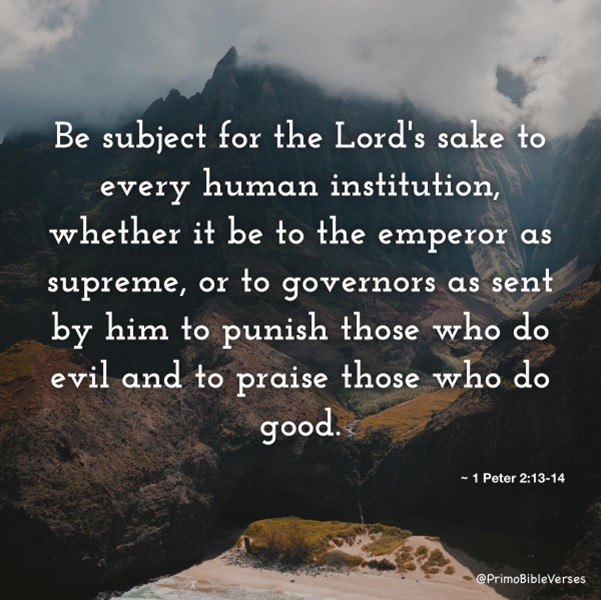
Are you willing to submit to people in authority over you? Your answer may reveal whether you are content to live as one of God’s chosen people in the world. The Bible teaches that submission is the appropriate demeanor for God’s children. In his writings Peter teaches that the child of God is to submit to “every authority,” whether in government, in employment, in marriage, in community, or in the church. These examples make a critical point. Since the Lord instituted authorities, to disobey them is to disobey him. What does it mean to submit? Like a car yielding to the flow of traffic, submission means blending into the flow of God’s kingdom work. It sounds simple enough, but most of us dislike the idea of submitting. Some even suggest it is the enemy of freedom. The truth, though, is that God provides grace and freedom through submission. Sin compels a person to live in an ever-shrinking universe called “me.” Submission is the grace that frees us from sin’s personal blinders by calling us to live within a community. The kingdom gospel is a world-embracing gospel, and I am to accept my civic responsibility in order to give expression to it.

PRAYER:

Written by Calvin Hoogendoorn, the author of today’s reflection.

Dear Lord, by your Holy Spirit give me courage to exercise the privilege of submission to you, your Word, your call, and to all authority that you have established. In Jesus’s name, Amen.