Feeds:
Posts
Comments

Rescue From Exile

MEDITATION:

Written by Nina Pope from the Village Church.

Exile is a lonely place—to me, the image that the word evokes is enduring sadness, isolation, helplessness, and hopelessness. It is the place that most everyone has been at one time or another and the place no one wants to be. Exile can be self-inflicted or circumstantial, and either way it is painful. Although not fully understood then, the grace of God hauled me out of a time of exile many years ago. I entered college with expectations that were fully unmet; I was taken by surprise that the experience I was having did not in any way resemble the vision I expected – for the first time in my life, I was the proverbial fish out of water and was stunned. Eventually, I connected with a few others who shared some common interests and thus began emerging from the overpowering exile that had overtaken me. Years later when I read the story of Jacob’s son, Joseph, who was stranded by his brothers in that pit hoping for rescue, I could identify.

Joseph waited, and God’s mercy and grace removed him from the pit and eventually lifted him to unexpected heights of glory and reconciliation with his family. Like Joseph’s, my own release from exile had a great impact on my future years. In retrospect, I realize God’s hand has always been on me. In good times and harder times, God has always escorted me, and I stake my very existence on that fact. All Fall, Jack immersed us in the notion that we build our lives on a foundation of infallible rock, so that no matter what comes our way, and the chips are down, there is no exile for us because we cling to the embrace of a caring, powerful, and triumphant God.

PRAYER:

Today’s Prayer is written by Christina Fox, a contemporary counselor, writer, speaker, and author.

Father in heaven, you are my rock. My shelter and place of safety. You are my firm foundation. You do not change. Nothing can move you. I thank you that in Christ, I am safe. He is my refuge and my fortress. Nothing and no one can snatch me from him. May these truths be my comfort and strength in these uncertain times. In Jesus’s name, amen.
Live Deeply

MEDITATION:

Written by Rebecca Madden, a contemporary director of Women’s Ministry.

Almost twenty years ago, Jay and I packed our four-year-old son, seven-year-old daughter, dog, and personal belongings in a Honda van with forty years worth of memories from a life in South Carolina in tow. We left our families, our friends, our church, and everything we had ever known for Jay’s adventure into full‑time ministry in Chicago. We also left our dream home with “For Sale” and “For Rent” signs in the yard. When we arrived in Chicago, we didn’t know a soul who lived there. I honestly felt like I had been carried into exile—especially when I was faced with shoveling a driveway full of snow while Jay was away at seminary. Don’t people know you don’t have to live like that?  In his book Run with the Horses, Eugene Peterson defines exile as “we are where we don’t want to be.” I think for the past eighteen months we have all been living in exile. Our freedom to go and do whatever and whenever was halted. Our paradigms completely shifted. According to Peterson, while the Hebrews were in exile, they thrived. They prayed more deeply. They were more creative. They discovered purpose, love, and meaning. Though they lost everything they thought was important, more importantly, they found God. The goal of our lives is not to live as comfortably as possible but to live as deeply as possible right where God has planted us—even while in exile.

PRAYER:

Today’s Prayer is written by Rebecca Madden, author of today’s meditation.

Dear Heavenly Father, I have been restless during this season and am ready for this exile to be over. Help me to find my rest in You. Help me to create, love, laugh, and dig down deep right where I am today. Amen.

Thrive Where You Are

MEDITATION:

Today’s meditation is an excerpt from “The Message Devotional Bible.”

Exile is traumatic and terrifying. Our sense of who we are is very much determined by the place we’re in and the people we’re with. When those things change violently and abruptly, we wonder who we are. The accustomed ways we have of finding our worth and sensing our significance vanish. When the first wave of emotion recedes, we’re left like a broken shell on a vast expanse of beach, in a suddenly foreign place, feeling that we are worthless and that our lives are meaningless…Israel’s exile was a violent and extreme form of what all of us experience from time to time. Inner experiences of exile can take place even if we never move from the street where we were brought up. We are exiled from the womb and begin life in strange and harsh surroundings. We are exiled from our homes at an early age and find ourselves in the demanding world of school. We are exiled from school and have to make our way the best we can in the uncertain and sometimes unsettling world of work. We are exiled from our hometowns and have to find our way through the disorientation of new states and unfamiliar cities. The essential meaning of exile is that we find ourselves separated from home. Exile is an experience of dislocation—everything is out of joint; nothing fits together.

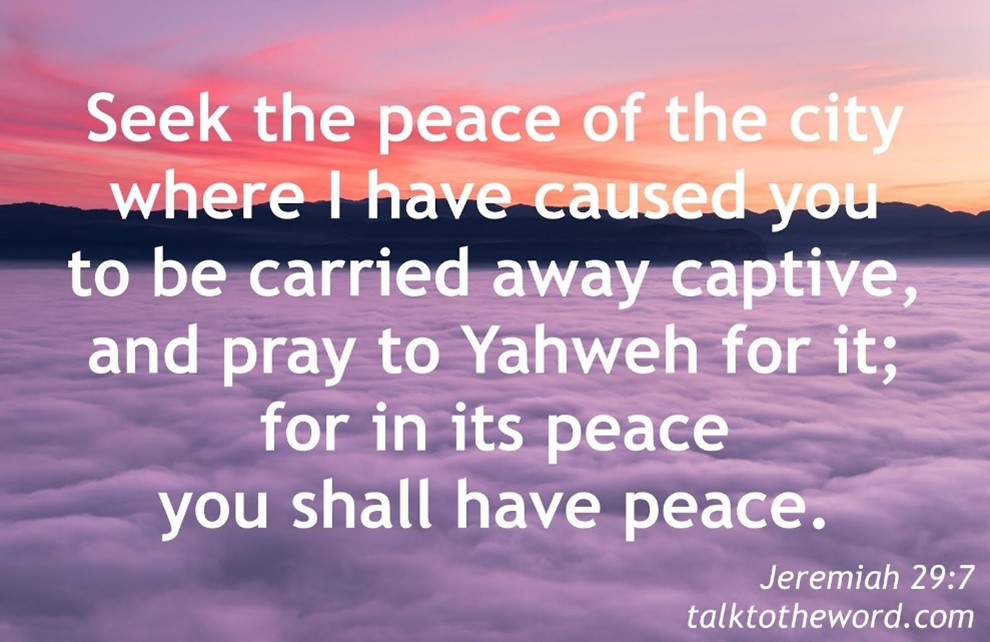
One day two men from Jerusalem—Elijah and Gemariah—appeared unannounced in Babylon. They had come on official business, carrying a message to the king. On their way to the palace, they visited the Hebrew community in exile. They came bearing a message from Jeremiah, who had received the message from God. “Build houses and make yourselves at home,” Jeremiah told the exiles (Jeremiah 29:5). You aren’t camping. This is your home. This may not be your favorite place, but it is a place. Dig foundations; build houses; develop the best environment for living that you can. If all you do is sit around and pine for Jerusalem, your present lives will be squalid and empty. “Put in gardens and eat what grows in that country,” he told them. Enter into the rhythm of the seasons. Become a productive part of the economy of the place. “Make yourselves at home there and work for the country’s welfare. Pray for Babylon’s well-being. If things go well for Babylon, things will go well for you” (verse 7). The Hebrew word for “welfare” is shalom, which means “wholeness”—the dynamic, vibrant health of a society that pulses with divinely directed purpose and surges with life-transforming love. Jeremiah essentially told the people, “Seek shalom. Throw yourself into the place you find yourselves. Not on its terms but on God’s terms. Pray. Search for that center in which God’s will is being worked out, and work from that center.” Jeremiah’s letter was a rebuke and a challenge to the Babylonian exiles: “Quit sitting around feeling sorry for yourselves. The aim of people of faith isn’t to be as comfortable as possible but to live as fully as possible. You will be in Babylon for a long time. You had better make the best of it. Don’t just survive—thrive. The only place you have to be human is where you are right now. The only opportunity you have to live by faith is in the circumstances you’re experiencing this very day—in this house you live in, in this family you find yourself in, and in this job you’ve been given to do.”

PRAYER:

Today’s Prayer is from “The Message Devotional Bible.”

Dear Lord, help me not to feel sorry for myself because of where you’ve called me to live my life. Whether I’m living in Jerusalem or Babylon, you’ve called me to yourself, to love you, to trust you, to obey you. Help me to see that you’ve also called me to more than that. You’ve called me to make the best of whatever exile I find myself in, to bless those around me, however foreign they may seem to me.  Amen.

The Long Way

MEDITATION:

Written by Vickie Stone from the Village Church.

A few years ago, a story in the Daily Word by Leslie Koh made me recall as a Human Resources professional the times I saw employees and supervisors be impatient with the pace of the climb up their career ladders.) Leslie told of a young employee, Benjamin, who was frustrated when his colleagues were promoted ahead of him.  Some of his family and friends would ask him “how come you’re not yet a manager? You deserve it.” But Benjamin decided to leave his career in God’s hands and figured if he learned all he could and did his job well, God’s plan for him would become evident. After a few years, Benjamin was indeed promoted and by then, his additional experience gave him the skills he needed to be confident in his job, but more importantly, won him the respect of his subordinates. In the meantime, several who were promoted ahead of Benjamin were struggling with their supervisory responsibilities, as they were promoted before they had the experience and skills to be effective. Benjamin realized God had taken him “the long way around” so he would be best prepared for his role.

Like the Israelites being led by God out of Egypt. God chose a longer way because the “shortcut” to Canaan was filled with perils. Bible scholars have observed that this gave the Israelites more time to build themselves up physically, mentally, and spiritually for subsequent battles. The shortest way isn’t always the best. Sometimes God lets us take the longer route in life, whether it’s in a career path or other endeavors, so that we’ll be better prepared for the journey ahead. When things don’t seem to happen quickly enough, we should trust always, in God, the One who leads and guides us. Ask God to help you trust in His sovereign plan and purpose for your life.

PRAYER:

Written by Lori Freeland, a contemporary author.

Lord, I’m stuck in a place I don’t want to be. It seems everyone else is speeding forward. It’s so hard to watch sometimes. What if my life always looks and feels this way? Things have to change. I must move on. I need something new right now.  But that’s not your way. You want me to grow when I want to run away. Soothe my anxiety. Take away my desperation. Stretch my perseverance. Thank you for knowing what’s best for me. Thank you for helping me let go and giving me the patience to wait on your timing not mine.   Amen.

Mournful Complaint

MEDITATION:

Written by Kurt Selles, a contemporary ministry director.

A jeremiad is a long, mournful complaint, a list of woes. This word came into use as a description of long, woe-filled passages in the book of Jeremiah. Indeed, the prophet rails repeatedly against the people of God in his day. The tone of Jeremiah’s entire book is lament because the sins of the people are truly depressing: idolatry, adultery, mistreatment of the poor and widows and orphans. God’s people, says Jeremiah, are like an unfaithful spouse and rebellious children. God’s judgment on such unfaithfulness will inevitably come, Jeremiah declares. And it does. God’s people lose the promised land and are exiled to Babylon. Jeremiah asks, “Is there no balm in Gilead? Is there no physician there?” Literally, the balm of Gilead was a topical medicine made from a local tree. But that’s not the treatment or the doctor Jeremiah is alluding to. He’s talking about a physician who can salve the eternal wound of rebellion and separation from God himself. He’s talking about salvation. Thankfully, God doesn’t leave his grieving people captive and far from home. Though the people suffer exile, God in his faithfulness heals and restores them. But the greater, eternal healing comes with the Great Physician, Jesus, who restores our souls.

PRAYER:

Written by Kurt Selles, the author of today’s meditation.

O Jesus, Great Physician, you alone are the balm we need to heal our sin-sick souls. We beg your forgiveness for our sins. Heal us, we pray. Amen.

Learning From Exile

MEDITATION:

Written by Leo Beach, a contemporary author. This is an excerpt from his book “The Church in Exile: Living in Hope After Christendom.”

Exile tends to infuse communities with new creative energy that rises to meet the challenges of new circumstances. Accordingly, the responses to exile that are offered by communities depicted in Scripture provide resources to the contemporary church and its own formation as an exilic people.  That is, exile is an appropriate motif for the Western church’s understanding of itself and its mission in its current setting; a robust biblical and practical theology rooted in both the Old Testament and New Testament visions of exile can inform the contemporary church’s self-understanding and mission…As exile was for Israel a time for self-evaluation and reorientation, so it can be for the church. The way forward is to look around and understand our context, to look back and gather the resources that our Christian faith offers us, and then to look forward with a clear vision of how the church ought to and can function as God’s people in contemporary exile…While exile was devastating for Israelite life and faith, and life for the early church was a continual challenge, their circumstances proved to be a time of development that generated a better future for both. As Ephraim Radner eloquently states regarding Israel’s exile, “Exile is also a movement by which our Lord delineated deliverance. As such, it can hardly be a cause for fear.” This can also be the case for the Western church in the twenty-first century if we are willing to learn from the wisdom of our ancestors in the faith.

PRAYER:

Today’s prayer is from Psalm 3, David’s prayer for deliverance.

Lord, how many are my foes! How many rise up against me! Many are saying of me, “God will not deliver him.” But you, Lord, are a shield around me, my glory, the One who lifts my head high. I call out to the Lord, and he answers me from his holy mountain. I lie down and sleep; I wake again because the Lord sustains me. I will not fear though tens of thousands assail me on every side. Arise, Lord! Deliver me, my God! Strike all my enemies on the jaw; break the teeth of the wicked. From the Lord comes deliverance. May your blessing be on your people.

Friendship in Exile

MEDITATION:

Written by Ruth Grendell from the Village Church.

My friend, Betty Simm, gave me her book of poems “Windows to My Soul”. Several years ago, Betty and her daughter, Kathy, moved to Utah to be with the family.  Now, our conversations are via phone calls and letters.  Every Christmas she sends the gift of a new poem to add to my collection.  During the Advent Season, the new poem is a reference for the time of looking forward to all the activities related to Christ’s birth. “It is our beginning, a spiritual birth. Jesus in human form proclaiming God with us”. However, during the six weeks of the Lenten season the gift of the poem encourages me to reflect on the life of Jesus—to acknowledge the purpose of His life; the impact on my life, my heart, and my mind.  I plan to select special times each day to reflect on the poem, to pray, to read the Scriptures as I acknowledge the true purpose of Christ’s life; to teach me, to be humble—to hope for the future, and to acknowledge his sacrifice for all of us. (If you see me wave my hand to the back of the sanctuary after the service, it’s to indicate that Betty, Kathy and I are still worshipping together as they are watching the service online).

PRAYER:

Today’s prayer is from the Roman Breviary, a liturgical book first published in 1482.  It is also known as “the Liturgy of the Hours.”

O Lord,

be our Sanctifier and the Shepherd.

Strengthen and help us,

that in our daily life walk with you,

we serve you in all quietness of spirit,

through Jesus Christ our Master. Amen.

Post-Christendom Exile

MEDITATION:

Written by J. Andrew Dearman, a contemporary professor of Old Testament studies. This is an excerpt from his work “Exile and New Life.”

The topic of exile and new life intersect with several pertinent matters today. The Assyrian and Babylonian exiles (or as some historians now describe it, “forced migrations”) are the primary example of corporate failure in the Old Testament. These events, moreover, play a major role in the shaping of the Old Testament canon. One of our most influential biblical theologians, N.T. Wright, has proposed that a continuing sense of exile in the post-exilic period among Jews is the matrix in which Jesus announced the advent of the anticipated Kingdom of God… Some of our contemporaries have suggested that the Babylonian exile is particularly worthy of study as a way to think about the broader phenomenon of post-Christendom and minority status in western societies. One American Christian has said recently, “Let’s stop the pity party and instead say, ‘We’re in exile and this is not the first time God’s people have been in exile”… Speaking personally, I want to cling to the prophetic model, whereby a historic moment of failure ushers in dramatic new ways of presenting the divine-human relationship, ways that are surely congenial with the paradigm of cross and resurrection in the New Testament. Good Friday’s death leads through Saturday’s deathly exile to the resurrection of Easter morning. I can hold also to the Torah’s proclamation that when my tribe and I are in exile, God can perform a miracle on our collective heart. But there is something both foreboding and formative about looking systemic failure squarely in the eye and admitting that I am complicit and feel helpless. 

PRAYER:

Written by Christopher McCluskey, a contemporary Christian coach and author.

Heavenly Father, we know we’re in a fallen world. We know that we’re to be cooperating with You and the ongoing redemption of this world until all things are made new. But Lord God, we find ourselves in a very unique and extremely painful and shameful state now, as we see ourselves sliding into a time of barbarism again, and anger and destruction on a scale that we’re not used to seeing present-day. Lord, we know that this grieves You even more than it grieves us, and we’re overwhelmed by it every day in the media. Heavenly Father, by your Holy Spirit, hear the prayers and petitions of your children. Heal our land. Heal our culture. Lead us into a greater capacity for listening in your Holy Spirit, by your Holy Spirit. Grant us the ears to hear as You hear and to hear what You’re wanting to say to us, and then and only then, use us as those mouthpieces, those vessels that You have in this broken world to bring healing. We pray in Christ’s name. Amen.

Humanitarian Aid

MEDITATION:

Written by Rev. Dr. Donald Owens, Associate Director, Christ Ministry Center/Safe Harbors Network, a mission partner of the Village Church.

Last year, during Lent, Safe Harbors Network was working to meet the needs of Asylum Seekers and immigrants showing up on the doorsteps of Christ Ministry Center. This Lent, we are still working to provide food, clothing, and temporary shelter. This Devotional reminds us that we do not pass through this season alone. In this community, we are surrounded by others with hopes, fears, faith, courage, and doubts. During this season, our goal is to recruit sponsor families who will provide shelter and support, so we can continue to make a difference in the lives of more refugees fleeing disasters, famine, droughts, criminal activity, violence, wars, poverty, or other unbearable circumstances. In this season of Lent, I reflect on a family that was found sleeping on the steps of Christ Ministry Center on a Sunday Morning at 1:30 a.m. I was called and asked what he should do; this family consisted of a husband, wife, and two tiny toddlers sleeping on the portal under a blanket in 40-degree weather. The family was brought inside the building and given additional blankets and food. Later that Sunday morning, I went to the church to meet the family and decided for the family to stay in a hotel. This family only wanted to get to New York to cross into Canada, where they had family. They needed money for a bus ticket to New York. The Staff of Safe Harbors Network purchased tickets and gave money for food for them to travel to New York. Our hearts are happy because the family made it to New York and crossed the border into Canada to unite with other family members. The family called to thank us for providing humanitarian aid. They call monthly to give us an update on their progress while making a living in Canada. To God be the glory for those who cross our pathway; as we continue to make a difference in the lives of more refugees fleeing disasters, famine, droughts, criminal activity, violence, wars, poverty, or other unbearable circumstances.  ‘ I pray that this Devotional will steadily touch the hearts of those who read it to provide humanitarian assistance to our brothers and sisters seeking asylum.

PRAYER:

Written by Catherine Gorman, a contemporary writer.

Father of all, there are many among us who go hungry. Help us to listen and respond as one family, so that, as we break bread together, we may glimpse your Kingdom here on earth – a Kingdom of welcome and plenty for all. Amen.

MEDITATION:

Written by Mark Woods, a contemporary pastor and head of Communications at The Bible Society.

From the eighth century BC, the two kingdoms of Israel and Judah were menaced by superpowers like Assyria and Babylon, and gradually got weaker. The northern kingdom of Israel was the first to fall – after 20 years of attacks by Assyria during which some of its people were taken into captivity, its capital Samaria fell in 722 BC. Many of the remaining people were dispersed throughout the Assyrian Empire, and others were brought in to replace them. As a nation, Israel was over. Judah lasted longer, but at the end of the seventh century, its decline began. King Nebuchadnezzar of Babylon besieged Jerusalem in 605 BC. Repeated attempts to resist him led to repeated defeats. Large numbers of the Judeans were taken into exile in Babylon in 597 BC, 586 BC – when Jerusalem was sacked and burned – and 582 BC. Zedekiah, the last king of Judah, tried to escape but was blinded after seeing his sons slaughtered (2 Kings 25.7).  For the stories of the last years of the kingdom of Judah and the Exile, read 2 Kings 25, 2 Chronicles 35–36, and the book of Jeremiah. The book of Daniel is set during the Exile, as is Psalm 137, which begins with ‘By the waters of Babylon we sat down and wept when we remembered Zion’, and the book of Ezekiel.   However, in 539 BC the Persian King Cyrus defeated the Babylonians and allowed the Jews to return. These stories are told in the books of Ezra and Nehemiah.

The Exile was important for lots of reasons. It meant the temporary end of Temple worship and the sacrificial system, which meant that the people had to think about what was really important in their faith. Could they really worship God without the things that had always supported them in their believing? It also saw the emergence of real scholarship, as scribes who could understand and interpret the Hebrew Scriptures – like Ezra – grew in prestige and significance. It meant that Jews were able to survive as a nation without being attached to the geographical land of Israel. Christians have drawn on the image of Exile to express our own relationship to the world. 1 Peter 2.11 says, ‘I appeal to you, my friends, as strangers and refugees in this world!’ Revelation 17.5 refers to ‘Babylon the Great’, the oppressive power that dominates our earthly exile. As the people of God, we’re not entirely at home in this world. But God brought the exiles home, and he has a home in heaven for us. 

PRAYER:

Written by Anne Peterson, a contemporary poet, speaker, and author.

Father God, I come before you, with gratefulness. Thank you for your promise that you will never leave us. Thank you for your touch in our lives. Lord, thank you that you hold our hands whenever we need you. Remind us of your presence, Lord. Thank you for your faithfulness. I pray this in Your Son’s precious and Holy name. In Jesus’ name, Amen.