Feeds:
Posts
Comments

Sunrise at the Beach

MEDITATION:

Written by Katie Minter Jones, a contemporary author.

Sunrise at the beach is my favorite place to worship and fully experience Jesus; I’m overwhelmed by His presence there. His majesty is displayed in the splendor of the sunrise as the rays paint the sky with beautiful shades of color. The roar of the waves proclaims His might. The smell of the salt in the air, the feel of the soft sand beneath my feet, and the cool mist all refresh me. When Jesus was on earth, He must have loved the sea also. The Bible tells several stories where He’s on the sea or at the beach. Jesus was walking by the Sea of Galilee when He called two fisherman, Peter and Andrew, to be His disciples, making them fishers of men. In Matthew 8:24–27, Jesus was on the boat asleep when the disciples became afraid and woke him. A storm was threatening to sink the boat, and Jesus calmed the wind and the waves, unleashing His power on the sea. Jesus didn’t stop there . . . He walked on the water. And after Jesus was resurrected, He stood on the beach at dawn, but the disciples did not recognize Him. They had been out all night, fishing without a single catch. He told them to cast their nets to the right side of the boat, and their nets became full. A miracle on the beach! Time after time, Jesus uses the backdrop of the sea to reveal His love to humanity. The Bible describes His love for us as being deeper than the ocean. The beach proclaims His majesty, His presence, and the depth of His love. Let the vastness of the ocean and the beauty of His creation remind you again today that His love for you is fathomless.

PRAYER:

This prayer is from the “Carmina Gadelica” six volumes of prayers, hymns, blessings, songs, proverbs, and literary folkloric poems from the Gaelic-speaking regions of Scotland. 

God the Father, all-powerful, all loving,

Jesus, the Son of tears and sorrow,

With thy co-assistance, O Holy Spirit!

The Three-One, ever-living, ever-mighty, everlasting,

Who brought the Children of Israel through the Red Sea,

And Jonah to land from the belly of the great creature of the ocean,

Who brought Paul and his companions in the ship,

From the torment of the sea, from the sorrow of the waves,

From the great gale, from the heavy storm,

Protect us and shield and sanctify us,

Be seated, O king of the elements, at our helm,

And lead us in peace to the end of our journey. Amen.

Immeasurably More

MEDITATION:

Written by Ray Stedman (1917-1992), a pastor and author.

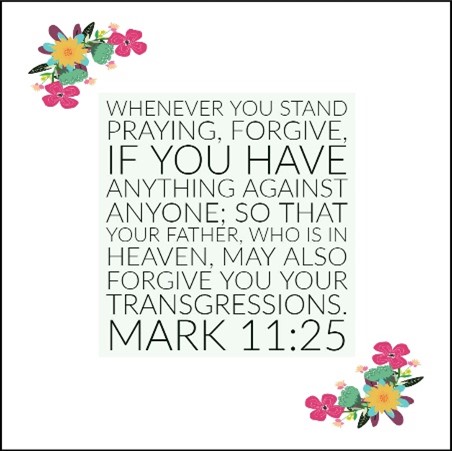
The great hindrance to having faith in God is pride, the pride that refuses to forgive. That is like a mountain that fills up your whole life. All you can see is that big mountain looming before you, and it is blocking the life of God in your life. You have the power to have that removed if, when you stand and pray, you will forgive those who have offended you. Because the only thing that stops us from forgiving one another is pride. We feel justified in wanting others to forgive us but also in feeling that we have to exact a price for the hurt they have caused us. So, in many ways—subtle, or direct and open—we insist that we will not forgive, that our offenders have to pay for what they have done to us. Somehow, we are going to make them crawl, make them beg or plead for forgiveness. And that, Jesus says, is a great mountain that needs to be removed, for it is blocking the flow of the life of God to your faith.

PRAYER:

Written by Cheryce Rampersad, a contemporary Christian author. 

Father, bless me with the wonderful power of forgiveness, give me the grace to unconditionally forgive those who have done me wrong. Fill my heart with love toward my fellowman. Let kindness be my first nature. Let peace consume my thoughts and tranquility overtake my soul.  Free me of all anger, bitterness, hate, and unforgiveness. Amen.

MEDITATION:

Written by G. K. Chesterton (1874-1936), an English writer, philosopher, Christian apologist, and literary and art critic. This is an excerpt from his book “Orthodoxy.”

We need not debate about the mere words evolution or progress: personally, I prefer to call it reform. For reform implies form. It implies that we are trying to shape the world in a particular image; to make it something that we see already in our minds. Evolution is a metaphor from mere automatic unrolling. Progress is a metaphor from merely walking along a road – very likely the wrong road. But reform is a metaphor for reasonable and determined men: it means that we see a certain thing out of shape and we mean to put it into shape. And we know what shape. Now here comes in the whole collapse and huge blunder of our age. We have mixed up two different things, two opposite things. Progress should mean we are always changing the world to suit the vision. Progress does mean (just now) that we are always changing the vision. It should mean that we are slow but sure in bringing justice and mercy among men: it does mean that we are very swift in doubting the desirability of justice and mercy. Progress should mean that we are always walking towards the New Jerusalem. It does mean that the New Jerusalem is always walking away from us. We are not altering the real to suit the ideal. We are altering the ideal: it is easier…We may say broadly that free thought is the best of all the safeguards against freedom… No ideal will remain long enough to be realized or even partly realized. The modern young man will never change his environment; for he will always be changing his mind. This, therefore is our first requirement about the ideal toward which progress is directed: it must be fixed…It does not matter (comparatively speaking) how often humanity fails to imitate its ideal; for then all its old failures are fruitful. But it does frightfully matter how often humanity changes its ideal; for then all its old failures are fruitless.

PRAYER:

Today’s prayer is from the United Church of Christ Book of Worship.

Grant us, Lord God, a vision of your world as your love would have it: a world where the weak are protected, and none go hungry or poor; a world where the riches of creation are shared, and everyone can enjoy them; a world where different races and cultures live in harmony and mutual respect; a world where peace is built with justice, and justice is guided by love. Give us the inspiration and courage to build it, through Jesus Christ our Lord. Amen.

The Ecstasy of Gratitude

MEDITATION:

Written by John Ortberg, a contemporary pastor, speaker, and author.

Ten men were cleansed. Ten were given their life back. Only one turned around. Nine ran the wrong way. Only one came back to thank the Giver for the gift. When I read the story of Jesus and the lepers, I wonder why the only grateful one was the Samaritan. I wonder if the fact that he was Samaritan and Jesus was Jewish made him that much more aware of what a gracious gift this was. Having too much can make a person ungrateful. The illusion of gratitude is that we will experience it more if we get new stuff that we really want. We tend to keep score by comparing ourselves to others. When it comes to affluence, for instance, we tend to follow what psychologist Leon Festinger calls the “principle of slight upward comparison.” We chronically compare ourselves with those just a little better off, in the hopes of attaining their level of success. This keeps us from gratitude. It also keeps our eyes off people who are under-resourced so that we don’t think about our need to share. God gives us the gift of the capacity for gratitude. Gratitude is the ability to experience life as a gift. It opens us up to wonder, delight, and humility. It makes our hearts generous. It liberates us from the prison of self-preoccupation. Gratitude is the gift God gives us that enables us to be blessed by all his other gifts, the way our taste buds enable us to enjoy the gift of food. Without gratitude, our lives degenerate into envy, dissatisfaction, and complaints, taking what we have for granted and always wanting more. We can have very little and yet be rich. A rich soul experiences life differently. It experiences a sense of gratitude for what it has received, rather than resentment for what it hasn’t gotten. It faces the future with hope rather than anxiety.
 We break rules — we violate God’s will — because we think breaking them will help us win, or at least avoid pain. But what we do not see is that the very breaking of them turns us into the kind of people who are increasingly incapable of the gratitude and purity of heart that makes lasting happiness and meaning possible. The great secret joy of life — the prize that we think getting richer will bring us — is the ecstasy of gratitude. Gratitude is how those rich toward God — rich in being, not just having — play the game. The apostle Paul discovered that whether he was living in luxury or living in prison he had more than enough because he had been freed from the treadmill of having. Are you experiencing the ecstasy of gratitude, or on the treadmill of having?

PRAYER:

Written by Richard John Neuhaus (1936-2009), a Christian cleric and writer.

Liberate us, we pray you, Lord, from the getting and grasping to which we are prone. Teach us the royal way of the law of the gift, that in giving not only things but ourselves we may know even now the life abundant you promise to bring to perfection in eternal life with you. Increase in us gratitude for your gift of yourself and let that gift of gratitude inspire us to the greatness of living our lives as love in response to love. Amen.

The Privilege of Prayer

MEDITATION:

Written by James Dobson, a contemporary author and his wife Shirley Dobson, a contemporary author and chair of the National Day of Prayer Task Force.  This is an excerpt from their book “Night Light for Couples.”

It’s tempting for some of us to view our Lord as a heavenly “Mr. Fix‐It”—a supernatural problem solver who can be manipulated according to our whims. We might make a little wager on our favorite football team and then pray for God to intervene so our team will win. Or on the day of the church picnic, we might pray for a rainstorm, so we don’t have to fix that potato salad we promised to bring. Others see prayer as a negotiating tool. They want to make a deal with God: “Lord, if You give me this promotion at work… or allow me to get pregnant this month…or let that car at the dealership still be on sale… then I promise I’ll do [fill in the blank] for You.” Of course, these are foolish bargains that reveal a misunderstanding of the majesty of God. He is Lord of lords, King of kings, and Creator of all heaven and earth. He is not a deal-maker who allows Himself to be manipulated. Instead, He wants us to carefully consider His will for our lives before we pray. Prayer is a privilege—a direct line to the Lord’s eternal wisdom and love. Let’s not forget what a blessing it is just to come into His presence.

PRAYER:

Today’s prayer is from the authors of today’s meditation.

Heavenly Father, thank You for the privilege of bringing our requests to You. Give us a deep desire for Your will—not ours—and help us to shape our prayers and our priorities accordingly. Amen.

Victimhood

MEDITATION:

Written by Henry Cloud, a contemporary Christian psychologist and author.  This is an excerpt from his book with John Townsend, “Boundaries With Kids.”

A woman complained to me about a coworker who would always interrupt her while she was trying to get her job done. She acted as if her tendency to be behind in her work was her coworker’s fault. “Why do you talk to her?” I asked. “What do you mean?” she replied. “When she comes in and interrupts, why do you get into a conversation with her?”  “Well, I have to. She is standing there talking.” “Why don’t you just tell her that you have work to do, or close your door and put up a ‘Do Not Disturb’ sign?”  The woman looked at me with a blank stare. To have choices and to have control of her own behavior was a concept that hadn’t occurred to her. She felt that if something happened “to her,” then that was the way it had to be. There was nothing she could do to change it. When I suggested that she had many choices, she quizzed me about them. I gave her five or six suggestions, from talking to the woman about the problem to talking to a supervisor, to asking to be moved to another area. This was a totally new way of thinking for her; she had never learned that she was free to make choices in relationships and in life.

Have you ever been in a relationship with a “victim”? Victims feel as if they have no choices in life. Life is something that happens to them, and whatever comes their way is their lot. Joe was such a victim. His company was imposing some new policies that he found difficult to handle, and he was very depressed about the changes. “What are you going to do about it?” I asked him. “What do you mean, do about it?” Joe asked. “I mean what are you going to do about your being stuck in something you don’t like?” He just looked at me. It took a long time before he realized that he could choose to get his resume out to some other firms and not be a victim to the fifty-hour workweek he hated. Adults and children raised with good boundaries learn that they are not only responsible for their lives, but also free to live their lives any way they choose, as long as they take responsibility for their choices. For the responsible adult, the sky is the limit. We live in a society of victims. People today act as if they have no choices in life and that everything should be done for them. If it’s not, they can’t do it themselves or make changes. This presents a big opportunity for the future: If you learn to take control of your own life, you will be so far ahead of everyone else that success in life is all but guaranteed!

PRAYER:

Today’s prayer is from The Mozarabic Rite, a liturgical rite of the Latin Church once used generally in the Iberian Peninsula (Hispania), in what is now Spain and Portugal.  Developed during Visigoth (Arian Christian) rule of the Iberian peninsula  in the 500s AD.

Look on us and hear us,

O Lord our God,

and help us to please you

as we do the work you have given to us.

As you have given the first act of will,

so give the completion of the work.

Give us strength to finish

what you have moved us to begin;

through Jesus Christ our Lord. Amen.

Jesus’ Yoke

MEDITATION:

Written by Dietrich Bonhoeffer (1906-1945), a German Lutheran pastor, theologian, author, and anti-Nazi dissident who was a key founding member of the Confessing Church.

Those who follow Jesus’ commandment entirely, who let Jesus’ yoke rest on them without resistance, will find the burden they must bear to be light. In the gentle pressure of this yoke, they will receive the strength to walk the right path without becoming weary.…Where will the call to discipleship lead those who follow it? What decisions and painful separations will it entail? We must take this question to him who alone knows the answer. Only Jesus Christ, who bids us follow him, knows where the path will lead. But we know that it will be a path full of mercy beyond measure. Discipleship is joy.

PRAYER:

Written by Dietrich Bonhoeffer, author of today’s meditation.

Lord Jesus, only you know where my path will lead, but I trust that, even if I do not know either the way or the destination, you are with me and before me, and I follow you with joy.

Good Works

MEDITATION:

Written by C. S. Lewis (1898-1963), a British writer and Anglican lay theologian. This is an excerpt from his work “the World’s Last Night.”

Just as the Christian has a great advantage over other men, not by being less fallen than they nor less doomed to live in a fallen world, but by knowing he is a fallen man in a fallen world; so we shall do better if we remember at every moment what Good Work was and how impossible it has now become for the majority. We may have to earn our living by taking part in the production of objects which are rotten in quality and which, even if they were good in quality, would not be worth producing – the demand or “market” for them having been simply engineered by advertisement. Beside the waters of Babylon – or the assembly belt – we shall still say inwardly, “If I forget thee, O Jerusalem, may my right hand forget it’s cunning.” (It will.)

PRAYER:

Written by Charles Spurgeon (1834-1892), an English Baptist preacher, known as the “Prince of Preachers.”

We bless You, O God, as the God of our redemption, for You have so loved us as to give even Your dear Son for us.  He gave Himself, His very life for us that He might redeem us from all iniquity and separate us unto Himself to be His peculiar people, zealous for good works. Amen.

Navigating Life

MEDITATION:

Written by Timothy Keller, a contemporary pastor and author.

Fools live in a dream of metaphysical self-sufficiency. They think they have everything sorted, and the complacency leads to disaster. But the opposite of complacency – anxiety – is no solution. We can lose our overconfidence and still be at ease, without fear if we remember that we have the omnipotent, sovereign Lord of the universe as our Father. If God did not spare us His own Son, how will He not give us whatever we need in Him through the power of the Holy Spirit?

PRAYER:

Today’s prayer is from the PC-USA Book of Common Worship.

God of love,

as in Jesus Christ you gave yourself to us,

so may we give ourselves to you,

living according to your holy will.

Keep our feet firmly in the way

where Christ leads us;

make our mouths speak the truth

that Christ teaches us;

fill our bodies with the life

that is Christ within us.

 In his holy name we pray. Amen.

MEDITATION:

Written by Anne Graham Lotz, a contemporary evangelist, author, and daughter of Billy Graham.

When the Holy Spirit comes into you at your invitation, you receive as much of Him as you will ever have. You do not get a little bit of Him then and a little bit more at a later time. Since He is a Person, you cannot get Him in pieces. You either have all of the Holy Spirit or you have none of the Holy Spirit. Why is it, then, that He seems to get us in pieces? He comes to us unconditionally, while we surrender to Him conditionally.

PRAYER:

Written by Francis of Assisi (c1181-1226), an Italian Catholic friar, deacon and preacher. He founded the men’s Order of Friars Minor, the women’s Order of Saint Claire, the Third Order of Saint Francis and the Custody of the Holy Land.

Whoever shall observe these things may he be filled in heaven with the blessing of the most high Father, and may he be filled on earth with the blessing of his beloved son, together with the Holy Spirit, the Consoler, and all the powers of heaven and all the saints. We adore You, O Lord Jesus Christ, and we bless You, because, by Your holy Cross You have redeemed the world. Amen.