Feeds:
Posts
Comments

Archive for the ‘Religion’ Category

God’s Glory

MEDITATION:

Written by Ligonier Ministries, the teaching fellowship of R.C. Sproul.

Any study of God’s glory would be incomplete without a look at what the term glory actually means. Setting forth a precise definition of the word glory, however, is no easy task. Like many other theological concepts, God’s glory is a concept that we have an awareness of without necessarily being able to describe it in all its fullness. When we think of the glory of the Lord, the image of brilliant light often comes to our minds. That is certainly appropriate, as Scripture often describes the glory of God in terms of a light that shines brighter than anything that we experience on earth. For example, Isaiah 60:1-3 speaks of the glory of our Creator and not the sun being the light that shines forth in this dark world, revealing itself through God’s people that they might point the pagan nations unto the Lord of all.  Revelation 21:22-25 tells us that in the new heaven and earth, creation will have no need for the sun by day or the moon by night because the glory of the Lord shall illumine all of creation. Other biblical passages connect God’s glory with his holiness and weightiness, that is, His significance. We see this with particular clarity in Leviticus 10:1-3 and the account of Nadab and Abihu, who offered strange fire before the Lord. Moses does not tell us precisely what “strange fire” means, but it is clear enough that Nadab and Abihu acted irreverently in their actions. In other words, they did not approach God with proper reverence and awareness of His divine dignity. They did not glorify the Lord, and so they were consumed by fire from on high. Besides helping us see that glorifying God requires us to understand His significance, holiness, and weightiness, this passage also informs us of the seriousness with which the Lord takes His worship. Coming together with God’s people to praise His name is a distinct privilege and not something we should take lightly.  Worship is a matter of life and death, and not just under the old covenant. The Apostle Paul tells us in 1 Corinthians 11:29-30 that partaking of the Lord’s Supper without giving due attention to its significance can kill us. We do not worship a God who can be regarded in a flippant or otherwise careless manner.

PRAYER:

The prayer today is from an ancient collect from the 6th century.

O God,

you have folded back the cover of the night

to clothe us in the golden glory of the day.

Chase from our hearts all gloomy thoughts,

and make us glad with the brightness of hope,

that we may effectively aspire to promised virtues;

through Jesus Christ our Lord. Amen.

Read Full Post »

MEDITATION:

Written by Mark D. Roberts, a contemporary Christian author. This meditation is from the Fuller DePree Center daily devotional, for which he is a principal writer.

Christ is risen! He is risen, indeed!

For centuries, Christians h ave greeted each other on Easter Sunday with these triumphant words. We celebrate the resurrection of Jesus not only because one we love has conquered death, but also because we share in his victory. Because Christ is risen, sin and death have been defeated. Because Christ is risen, we are saved. To use the language of 2 Corinthians 6:2, “now is the day of salvation.” The salvation we have in the risen Christ includes the assurance of the fullness of life in God’s future. One day, we too will be raised with Jesus, thanks be to God. But we begin to live in the reality of salvation today. “Now is the day of salvation,” Paul exclaims. Thus, we mustn’t “receive God’s grace in vain” (6:1). Rather, we should allow the grace of God given in Christ to transform us, inspire us, and empower us so that we might live for God and others in God’s name. Though God has done all that is necessary for salvation through Jesus Christ —who died on Good Friday and was raised on Easter—we are nevertheless “God’s co-workers.” Even as God created humankind to cooperate with God in the stewardship of the earth, so we also work with God in passing on the message of salvation in Christ. Through living as people in which God’s grace is alive and through speaking of what God has done to save us through Christ, we, along with the Apostle Paul, are God’s co-workers. Thus, as we celebrate the resurrection of Jesus on this day of salvation, we also commit ourselves once again to receiving God’s grace fruitfully and to living our whole lives as God’s co-workers. May God receive all the glory!

PRAYER:

Written by Rachel Marie Stone, a contemporary writer, editor, and speaker.

Lord God, you loved this world so much that you gave your one and only Son, that we might be called your children too. Lord, help us to live in the gladness and grace of Easter Sunday, every day. Let us have hearts of thankfulness for your sacrifice. Let us have eyes that look upon your grace and rejoice in our salvation. Help us to walk in that mighty grace and tell your good news to the world. All for your glory do we pray, Lord, Amen.

Read Full Post »

MEDITATION:

Written by John Piper, a contemporary theologian and pastor. This is an excerpt from his book “Love to the Uttermost.”

As I read these terrible words [Luke 22:63-65], I found myself saying to Jesus, “I’m sorry. I’m sorry, Jesus. Forgive me!” I felt myself to be an actor here, not just a spectator. I was so much a part of that ugly gang that I knew I was as guilty as they were. I felt that if the rage of God should spill over onto those soldiers and sweep me away, too, justice would have been done. I wasn’t there, but their sin was my sin. It would not have been unjust for me to fall under their sentence. Has it ever bothered you that sometimes in the Old Testament when one man sins, many get swept away in the punishment God brings?  An analogy came to my mind. The hearts of humanity are like a molten mantle beneath the surface of the whole earth. The molten lava beneath the earth is the universal wickedness of the human heart—the rebellion against God and the selfishness toward people. Here and there a volcano of rebellion bursts forth which God sees fit to judge immediately. He may do so by causing the scorching, destructive lava to flow not only down the mountain which erupted, but also across the valleys which did not erupt, but which have the same molten lava of sin beneath the surface. The reason I confess the sin of beating Jesus, even though I wasn’t there, is that the same lava of rebellion is in my own heart. I have seen enough of it to know. So even though it does not burst forth in such a volcanic atrocity as the crucifixion, it is still deserving of judgment. If God had chosen to rain the lava of their evil back on their own heads and some of it consumed even me, I would not be able to fault God’s justice… How widely the lava of one person’s rebellion and judgment will flow lies in God’s hands alone. And I believe from Romans 8:28 that, even though the lava of recompense overtakes me at a distance from the volcano, there is mercy in it. I do not deserve to escape, for I know my own heart. But I trust Christ, and so I know the judgment will be turned to joy. Though he slay me, yet will I trust him. For precious in the sight of the Lord is the death of his saints.

PRAYER:

From the Byzantine Rite Matins for Great and Holy Saturday, developed in the 4th century and still used by the Eastern Orthodox church today.

Today the one who holds all creation in his hand is himself held in the tomb, a rock covers the One who covered the heavens with beauty, life has fallen asleep, Hades is seized with fear, and Adam is freed from his bonds. Glory to your work of salvation; through it you have accomplished the eternal Sabbath rest, and You grant us the gift of your holy resurrection.

MUSIC MEDITATION:

Jesus Paid It All. Kim Walker-Smith. Written by Elvina Hall in 1865.

Read Full Post »

MEDITATION:

Written by Margot Wallace.

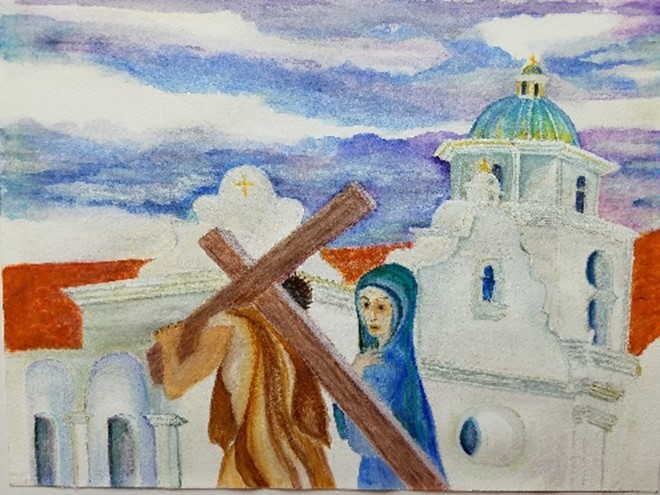
Have you ever had to face your Mother at the lowest point in your life? The embarrassment and shame experienced upon the recognition by another, especially by a parent, of one’s inescapable situation is sometimes beyond words.  The event of Jesus meeting his Mother took place on the road to Golgotha before Simon of Cyrene was compelled by the guards to carry his cross. Only their eyes meet as Jesus’ mother, Mary, acknowledges his scorching pain, now beyond his control. This is known by some as the 4th station of Jesus’ cross.  Here Mary remains resolute in remorsefulness of this predicted moment. Her heart is heavy and breaks with sorrow.  In loving awareness, she feels her child’s suffering. The picture below was painted on site at San Louis Rey mission in Oceanside. Mary and Jesus are life-size bronze statues in the front of the Mission.  They are portrayed in the painting as in real-life.

PRAYER:

A prayer for Good Friday from the PC USA Presbyterian Mission Agency.

Holy God, we remember Pilate’s question: What is truth? Now we have seen the truth: Jesus Christ, your Word made flesh, betrayed, denied, mocked and beaten, put to death on a cross, buried in the tomb. Lord, have mercy. Christ, have mercy. Lord, have mercy on us. We have seen the truth. But there is more … now show us the truth of your saving power; show us the way beyond the grave; show us the life that is everlasting; through Jesus Christ our Lord.


Wattercolor “Jesus Meets His Mother, 4th Station of the Cross. Painted by Margot Wallace. John 19:26.

MUSIC MEDITATION:

Were You There When They Crucified My Lord?. Pegasis. The song is an American spiritual that was  first published  in 1899.

Read Full Post »

MEDITATION:

Written by Jay Shailer, a contemporary pastor.

The parade is over. The singing and joyous celebrating are now just a memory from Sunday. The palms are all cleaned up, and the city of Jerusalem is quiet. Tonight, we get one last meal with Jesus. But, before the action picks up in Gethsemane tomorrow, we get one last lesson from our Lord. He tells us to love each other. He doesn’t just give it lip service. He gets down on his knees, pours water into a bowl, and washes the disciples’ dusty feet. This is the love he speaks about. Humble, lowly devotion to the ones you love. It’s a love that carries no glamour. It’s a love that gains you nothing other than sideways glances from others, who would never do something that is beneath them. Jesus is showing us that love is costly. But more importantly, it is holy. How we love each other echoes an eternity. It is how we identify ourselves as followers of Christ. It is our calling card for the world.

As we, the church, enter into the great three days of Christ’s death and resurrection, I pray we hear this one last lesson about our identity as citizens of God’s Heavenly Reign. People will know us by how we love each other. People will know. People will see where our hearts and our values are by how we fall to our knees and reach out in service to our neighbor. Our promise in Jesus’ resurrection is firm, and our call and identity are clear. When we get to the other side of the big celebration Sunday morning, and those decorations are cleaned up, and we go back out into the world, I pray that this identity shines brightly and clearly.

PRAYER:

Written by Anselm of Canterbury (1033-1109), a Benedictine monk, abbot, philosopher and Christian theologian. He served as the archbishop of Canterbury from 1093-1109.

O blessed Lord, you have commanded us to love one another. Just as we have received your undeserved blessings, may we love everyone in you and for you. We ask your kindness for all, but especially for the friends whom your love has given to us. Love them, O fountain of love, and move them to love you with all their heart, that they may will, and speak, and do only those things which are pleasing to you. Our prayer is cold,  because our love is so feeble, but you are rich in mercy. Do what is best for them, according to your will,  that being ruled and protected by you always and everywhere;  to you, with the Father and the Holy Spirit,  be all honor and praise for ever and ever. Amen.

MUSIC MEDITATION:

God of Mercy and Compassion. Sherrin Sophia. The hymn was written by Edmund Vaughan in the 1700s and traditionally is set to the French tune Au Sang Qu’un Dieu by Giovanni Pergolesi.

Read Full Post »

Listening To God

MEDITATION:

Written by Pat Grant.

Lent is meant to be a time of solitude and reflection in preparation for the burst of shining glory and abundance of Easter to come. In bygone years of an agrarian society, the land was left fallow.  Crops would be planted when the sun warmed the earth. Lent meant “slow” and through the grey days, everything slowed down and waited. No barn dances, no socials, no potlucks. The year just passed has certainly resembled a prolonged Lenten season in many ways. It has been a time of concern about the future and every other person on the planet. It has introduced us to a life with no barn dances, no socials, no potlucks.

The past year often felt unreal to me and only God was real. God is never closer than when things get grim. And this year was grim.   One of my favorite Bible verses is Isaiah 6:8.  “ I heard the voice of the Lord saying, ‘Whom shall I send and who will go for us?’“ Isaiah hears, and he volunteers. But no matter how hard I try, I don’t hear any special instructions for me. Oswald Chambers in “My Utmost for His Highest“ suggests that if we don’t hear, the reason is we’re doing all the talking. In the midst of his hard times, Isaiah listens to the Lord and that’s the secret of two-way communication. 

— “Stop talking, Pat.  Listen.”   —”I’ll try!”

PRAYER:

This prayer is from the Gallican Sacramentary. an historical version of Christian liturgy within the Latin church in the 1st Millenium.

O God,

you are the author of love,

and you love pure peace and affection.

Heal the diseases of all Christians who are sick,

and in your great mercy set free

all who are terrified by fears,

afflicted by poverty,

weary with trouble,

worn down by illness,

burdened with punishment,

and all prisoners and wanderers.

Show them your compassion daily,

lift them up, correct them,

and protect them.

MUSIC MEDITATION:

Do Not Be Afraid For I Have Redeemed You: Marilla Ness. Written by Gerald Markland in 2008 and is based on Isaiah 43:1-2.

Read Full Post »

Forgive Them

MEDITATION:

Written by Jack Graham, a contemporary pastor and author.

As we all know, words are powerful… especially dying words. And as we near Easter Sunday, it’s important that each of us remembers just exactly what Jesus had to say right before His earthly life ended. One of the last things Jesus said while hanging from the cross were words of forgiveness. Today I want to ask you, if Christ could pray a prayer of forgiveness for those who were putting Him to death, can you pray a prayer of forgiveness for those in your life who mistreat you? Despite what you may be going through today, can you look past your own “junk” and extend forgiveness to others?

Jesus’ dying words on the cross are a powerful example of how you and I ought to treat those who mistreat us. Are you willing to follow His perfect example in every area of your life today? Will you extend forgiveness to those who don’t deserve it? I challenge you to pick up your cross today… and live out the life of forgiveness Christ has given you! 

PRAYER:

Written by Kristine Brown, a contemporary Christian author and speaker.

Dear Merciful Lord, thank you for your gift of forgiveness. Your only Son loved me enough to come to earth and experience the worst pain imaginable so I could be forgiven. Your mercy flows to me in spite of my faults and failures. Your Word says to “clothe yourselves with love, which binds us all together in perfect harmony.” Help me demonstrate unconditional love today, even to those who hurt me. 

MUSIC MEDITATION:

Forgiveness: Matthew West. Written by Matthew West in 2012.

Read Full Post »

COVID Time

MEDITATION:

Written by Michael Dyer.

It is amazing how unexpected interruptions in one’s life can contribute to important personal change. I recently contracted Covid-19. Fortunately, my symptoms were very mild. The main consequence of it for me was a forced quarantine. Normal activities both inside and outside my residence were prohibited for TWO WEEKS. A completely new schedule of activities was required. I was like a university professor on sabbatical!

Fortunately, the disruption gave me the opportunity to develop a few spiritual habits to prioritize time with God in my daily schedule, to devote more time to reading the scriptures and reflecting on the passages, and prayer. I began with small steps…starting the day with the Village Church Daily Devotional I receive via email. I started compiling a prayer list and reading a few psalms to start my day. Psalm 51 was a staple. Next, I scheduled time to watch the weekly Bible Study on Romans that our Pastoral Staff prepares.  Finally, I resolved to refer to my prayer list three times per day to ask for God’s favor and healing power to be granted to myself and others in specific need. Amazingly, I had time to do this yet ample time remained during the day for other tasks and duties. An interruption in my schedule to address a personal health issue instead contributed even more greatly to an improvement in my spiritual health. This is a daily routine I plan to continue with, even when the COVID crisis passes.  Our God works in mysterious ways….what a blessing!

PRAYER:

From the Gallican Sacramentary, an historical version of Christian liturgy within the Latin church in the 1st millennium.

O God, set us on fire with your Spirit. Strengthen us with your power. Enlighten us with your splendor. Fill us with your grace. Draw us forward with your help.

O Lord, give us a right faith, perfect love, true humility. O Lord, give us simple affection, brave patience, persevering obedience, perpetual peace, a pure mind, a right and clean heart, a good will, a sharpened conscience, spiritual strength, a life unspotted and blameless. And having finished the course, enter your kingdom by your grace. Amen.

MUSIC MEDITATION:

Psalm 51: Jason Silver.  Psalm 51 is put to music, as arranged by Jason Silver.

Read Full Post »

Singleness of Focus

MEDITATION:

Written by Eugene Peterson (1932-2018), an American theologian, minister, author, and poet best known for The Message: The Bible in Contemporary Language.  This is an excerpt from his book “God’s Message for Each Day.”

God is not one among many. When we pray we are not covering our bases. Prayer is not a way of checking out a last resort of potential help. We understandably want to explore all the options: we write letters, make telephone calls, visit prospects, arrange interviews. We don’t know who might be useful to us at any one time. Of course, we cultivate God. But not in prayer. We try it, but it doesn’t work. Prayer is exclusive. Prayer is centering… We can’t pray with one eye on the main chance and a side glance for God. Prayer trains the soul to singleness of focus: for God alone. The Psalms were not prayed by people trying to understand themselves. They are not the record of people searching for the meaning of life. They were prayed by people who understood that God had everything to do with them. God, not their feelings, was the center. God, not their souls, was the issue. God, not the meaning of life, was critical. Feelings, souls, and meanings were not excluded — they are very much in evidence — but they are not the reason for the prayers. Human experiences might provoke the prayers, but they do not condition them as prayers.  

The Israelites didn’t think they could sing the Lord’s song in a strange land. But they did. My, how they did! How did they do it?… They immersed themselves in Torah-meditation: before they knew it they were praying. They were trees. Transplanted to Babylon they put down roots, put out leaves, and produced fruit.  We all suppose that we could pray, or pray better, if we were in the right place. We put off praying until we are where we think we should be, or want to be. We let our fantasies, or our circumstances, distract us from attending to the word of God that is aimed right where we are, and invites our answers from that spot.  My soul waits. Another will is greater, wiser and more intelligent than my own. So, I wait. Waiting means there is another whom I trust and from whom I receive. My will, important and essential as it is, finds a will that is more important, more essential…I begin to pray by attempting to manipulate the will of God. I end by putting myself in a position to be moved by His will. Waiting in prayer is a disciplined refusal to act before God acts.  

PRAYER:

This prayer is from a 6th century collection of prayers.

Bless all who worship You, from the rising of the sun unto the going down of the same. Of Your goodness, give us; with Your love, inspire us, by Your spirit guide us; by Your power, protect us; in Your mercy receive us now and always. Amen.

MUSIC MEDITATION:

The Lord’s Prayer: Charlotte Church. The performance was recorded live from Jerusalem in 2001.

Read Full Post »

God in the Wilderness

MEDITATION:

Written by Sarina Odden Meyer, a contemporary American pastor, and author.

Many of us have experienced a wilderness in life—a time of trial or difficulty that forced us to drill down to the essentials of who we are, especially we who are in Christ. That is what the Israelites experienced in the wilderness. They were totally dependent on God. Their dependence was always at the forefront of their minds, because they were literally helpless without God’s provision. As they neared the land of plenty, God exhorted them to continue to follow God’s commandments, to continue to live in the fear of the Lord. Living in the fear of the Lord is a liberating concept. It is an invitation to worry only about what God thinks over and above what anyone else thinks, even ourselves. Times of wilderness are often blessings that bring us back to the essentials of who we are in Christ. It’s times of plenty that we have to worry about. In times of plenty, we think we can strike out on our own and live by the bread we make with our own hands. Instead of blessing God for all that God has given to us, we go astray, no longer living for God but living for ourselves or other people. As we approach a time of plenty, we are reminded to  “Take care that you do not forget the LORD your God” [Deuteronomy 8:11]. God has called each one of us uniquely to participate in the redemption of the world. When we forget God and start living for other things or other people, we forsake that which God has uniquely called us to do. During Lent, let us fast from the fear of other people, the fear of other things, even the fear of our own thoughts. Let us instead turn back to God and live in the fear of God only by remembering that “one does not live by bread alone, but by every word that comes from the mouth of God.” 

PRAYER:

Written by Sarina Odden Meyer, author of our meditation.

Gracious God, you know how easy it is for us to be driven by the fear of other people, other things, and even our own thoughts. Help us to be motivated instead only in fear of you. Help us to see that fearing you is an invitation to living fully into the calling you have uniquely given to us. Help us to seek you in times of wilderness and in times of plenty, so that in all the times we live through we will faithfully reflect your love in the world. In Jesus’ name we pray. Amen.

MUSIC MEDITATION:

Softly and Tenderly: Kristyn Getty, Vince Gill, Ellie Holcomb, Sierra Hull. The song is from a collection of hymns and lullabies the Gettys use to close each day with their own families. The hymn was written by Will Thompson in 1880.

Read Full Post »

« Newer Posts - Older Posts »