Feeds:
Posts
Comments

Archive for the ‘Religion’ Category

MEDITATION:

Written by Wendy Miller, a contemporary author. This is an excerpt from her book “Learning to Listen.”

We do not come to be with Jesus because we are righteous or strong. The people gathered around Jesus because they were needy. In his sermon, Jesus begins to explain the profound difference between the religious leaders’ teaching about attaining righteousness through their interpretation of the Law and traditions and the greater righteousness that moves beyond the Law to a relationship with God in Jesus Christ. Our sinful, restricted self is uncomfortable and fights being revealed. But deeper within us is the longing for God, placed within our true self by God. We come to God as we are: caught by sin and longing for God, and we are always met by God’s grace and mercy.

PRAYER:

Written by Allan Sabroso, a contemporary liturgy coordinator.

Father in heaven, our hearts desire the warmth of your love, and our minds are searching for the light of your Word. Increase our longing for Christ our Savior and give us the strength to grow in love, that the dawn of his coming may find us rejoicing in his presence and welcoming the light of his truth. We ask this in the name of Jesus the Lord. Amen.

Read Full Post »

The Beauty Remains

MEDITATION:

Written by Gary Chapman, a contemporary pastor, author, and radio talk show host.

The French artist Pierre Auguste Renoir was a leader in the early Impressionist movement of the nineteenth century. For the last two decades of his life, Renoir had to adapt his painting style to accommodate debilitating rheumatoid arthritis. He sometimes strapped a brush to his immobile, deformed fingers in order to continue his work. He also took up sculpting, directing others to act as his hands. He completed some of his most famous works when he was in the advanced stages of his illness. One of Renoir’s closest friends was the artist Henri Matisse. On one occasion, as Matisse watched his friend struggle to apply each brushstroke, Matisse asked, “Why do you continue to paint when you are in such agony?” Renoir replied, “The beauty remains; the pain passes.” Renoir’s words remind us of the hope God offers when we are patient in the face of disappointment and pain. One of the two Greek words translated as “patience” in the New Testament is hypomone, which means “to remain under.” This kind of patience speaks of being faithful to God’s calling even when things seem hopeless and loving others even when they seem unlovable. It speaks of trusting that our pain will pass but the beauty of God’s work in us—and through us—will remain for eternity.

PRAYER:

Written by Adrian Rogers (1931-2005), an American pastor and author.

Lord, I am weary and don’t know when this “race” will end in my life. I feel like I’ve been running forever, trying to outrun this trial. Help me to stop trying to outrun my pain but rather run with endurance the race you have set before me. I know that because of you I am ultimately a victor over the trials in my life. I know that nothing in this world can separate me from your steadfast love. Please give me a measure of your love today; give me the strength to endure this trial. Thank you for your love for me that never ends! And thank you for the crown of joy that awaits me forever in your Kingdom!

Read Full Post »

Working and Sharing

MEDITATION:

Written by George Young, a retired missionary and pastor.

Again and again, the Bible calls us to share with people in need: in the Law of Moses, in the Prophets, in Jesus’ teaching, and in the letters of Paul. The command to work hard, “doing something useful with [our] own hands,” earning enough that something might be left over, goes hand in hand with being compassionate. Paul presents working and sharing as a way to climb out of a dishonest way of life. There’s something clean and good about doing something useful—and then giving the surplus away. It reverses the old way of life in which a person would steal from unsuspecting, innocent passers-by, often by lurking in dark places and waiting to prey on them. Paul calls us back from the abyss of a corrupt life to the truth that our first ancestors had God-given work to do. How good to plant seeds, water them, and see them send up shoots; how good to tend and prune and sweep, taking care of the garden of creation we were given. Paul shows us a way of life that is characterized by growth in Christ, in a loving community of believers who do something good and useful—not sitting around idly gossiping, sniping at each other, fueling conflict and bitterness. How wonderful is the fellowship of loving, kind, compassionate people redeemed by Christ!

PRAYER:

Written by George Young, the author of today’s meditation.

God, help us to see the needs of others not as interruptions to our day, but rather as opportunities to reflect the love of Christ for people who need it. In his name, Amen.

Read Full Post »

Discipleship Experience

MEDITATION:

Written by Edward J. Farrell (1907-1993), a priest and author.  This is an excerpt from his book “Gathering the Fragments.”

A disciple experiences a joy and peace so deep within that he or she is compelled to share it with others. When this hidden mission begins to emerge in us, we find other people who also know that they have been haunted by Jesus and are drawn to each other to grow together in him. When we begin to follow Jesus, we allow him to live more consciously in our lives. In surprising and simple ways, he is always speaking to us. He is at the heart of the world and at the heart of each of us, especially at the fragile center where we are afraid—of ourselves, of others, of God. Fragile people are such a revelation of God.

PRAYER:

Written by Meg Bucher, a contemporary writer and teacher.

Father, this is the day you have made, so let us rejoice and be glad in it. You know what today will bring, and what tomorrow’s needs will be. If we awake to breathe today, we can be assured it is with great purpose, in order to bring glory and honor to You, the One True God. Jesus, our Savior, Friend, and Redeemer, it is through You we come to the Father, and spread the love of the Gospel. Remind us, through Your Spirit who convicts and comforts us, of your truth.

In moments when we find ourselves slumped into the places we land when things unravel, we know you meet us there in comfort and to supply the strength we need to stand again. Use our lives as vessels of love and truth. Let us see ourselves through the lens of faith, and the Father’s purposeful perspective. The author of Hebrews reminds us not to neglect to do good and share what we have, because such sacrifices are pleasing to You, Father.

We know all good things come from You, and You make good, all things. Let us share in the good works you have prepared for us, by the outflowing of our faith in Christ, to the people You have placed in our lives. We pray for Your favor, God, and Your protective embrace, as we look out into the world to do good and share what we have.

In Jesus’ powerful name we pray,  Amen.

Read Full Post »

God and Glory

MEDITATION:

Written by James I. Packer (1926-2020), an English-born Canadian evangelical theologian, cleric, and writer. This is an excerpt from his book “Hot Tub Religion.”

If it is right for man to have the glory of God as his goal, can it be wrong for God to have the same goal? If man can have no higher purpose than God’s glory, how can God? If it is wrong for man to seek a lesser end than this, it would be wrong for God, too. The reason it cannot be right for man to live for himself, as if he were God, is because he is not God. However, it cannot be wrong for God to seek his own glory, simply because he is God. Those who insist that God should not seek his glory in all things are really asking that he cease to be God. And there is no greater blasphemy than to will God out of existence.

PRAYER:

From the Syriac Liturgy of the third or late 4th century.

Father in Heaven, I pause and I look to You. Fan the flame within me, Lord! Bring life to the gifts You’ve imparted to me! Open my eyes to see evidences of Your glory everywhere I turn. Put faith in my heart to step out, to be a necessary miracle in somebody’s life today. And as I wait for my own personal breakthroughs, work through me to help someone else break through to their next place of promise. I love You, Lord. I need You every hour. And I have You every moment of every hour. I’m abundantly blessed. Amen.

Read Full Post »

Godly Wisdom

MEDITATION:

Written by Mark D. Roberts, a contemporary pastor, speaker, and seminary professor.

Do you ever feel as if you aren’t quite sure what to do next? It could happen in the context of your work, where you’ve got a tricky personnel issue, a boss who’s overly demanding, or a client whose preferences aren’t obvious. We often feel perplexed about relationships with family and friends. Perhaps you’re wanting to be a good parent to a teenager or a good friend to someone whose hurting, but you’re just not sure how to act. There was a time when, if we found ourselves in situations like these, people would tell us we need wisdom. These days, however, we don’t talk about wisdom nearly as much as we used to. We’re more apt to want to “fix things,” to look for “solutions,” or to look to Google for “the right answer.” We’re less likely to think, “I really need wisdom here.” But wisdom is what we need, now more than ever as the world becomes more complex, more uncertain, and more volatile. We need wisdom at work and at home, in our neighborhoods and churches, and in a world filled with unprecedented and unruly problems. Wisdom isn’t the same as knowledge. Wisdom is judging what’s best or having good sense. It’s knowing how to live well and choosing to do so.

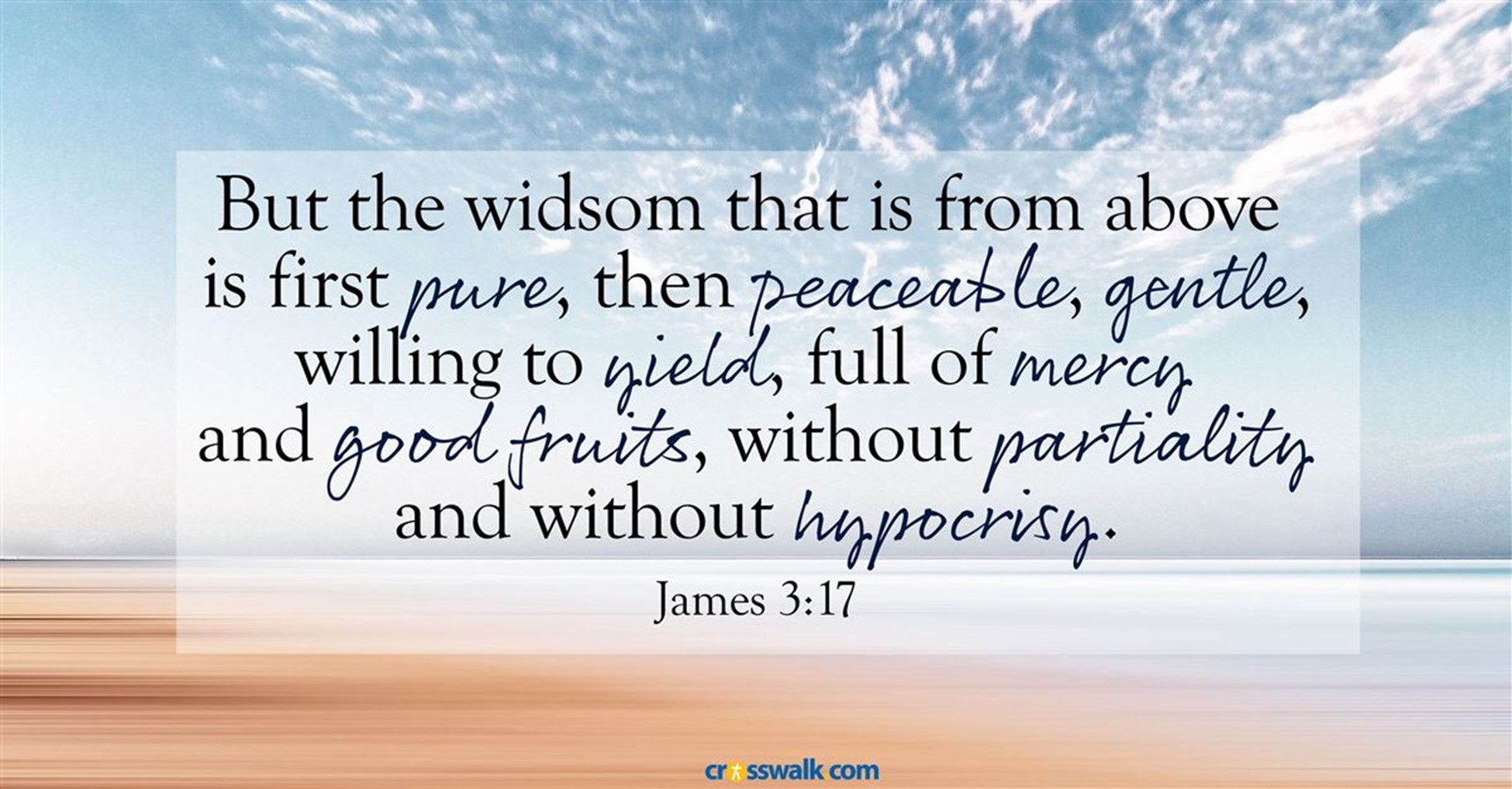
Yes, we do need wisdom, but not just any kind of wisdom. There are versions of wisdom that are neither truthful or helpful. The Letter of James in the New Testament labels such wisdom as “earthly, spiritual, devilish” (James 3:15). James doesn’t mean that all practical wisdom, such as what you get from years of experience in a job, is necessarily wrong. But he does recognize that what the world regards as wise can sometimes lead us astray. In addition to common wisdom that comes from living attentively, we need wisdom of a special sort. James calls it “wisdom from above” (James 3:17). This is, of course, an understated way of saying we need wisdom from God, who dwells in Heaven above. Wisdom from above is godly wisdom, divine wisdom, supernaturally uncommon wisdom. It excels all over other kinds of wisdom because of its source. It comes from the “only wise God” (Rom 16:27). Sometimes we might assume that such wisdom is only relevant to “spiritual things.” It matters only to how we pray, read the Bible, worship, and share our faith with others. But, in fact, wisdom from above touches every part of life. James writes, “Show by your good life that your works are done with gentleness born of wisdom” (James 3:13). Wisdom has everything to do with living well in all segments of life, including our work, personal finances, citizenship, and neighborliness.

Now you may already be convinced that God’s wisdom is relevant to all of life. You may regularly seek “wisdom from above” throughout each day. If so, that’s great, though most Christians recognize that they’d like to be more attentive to God’s guidance. Alternatively, you may not seek divine wisdom for the practical, everyday matters at work, home, and beyond. You may see that you need to learn to receive “wisdom from above” for the challenges and opportunities you face each day…As you face the complexities of life, know that you’re not on your own to figure out what’s best. There is “wisdom from above” available to you. In fact, the “only wise God” is able and eager to share divine wisdom with you, to help you live well in every part of life. That is good news, indeed.

PRAYER:

Written by Mark D. Roberts, author of today’s meditation.

Gracious God, you are wise beyond anything I can imagine. Your wisdom brought the universe into existence. It stretches across space and time. Nothing hides from your wisdom. Thank you, dear Lord, for being willing to share your wisdom with me. I do need “wisdom from above.” I confess that sometimes I act as if I have all the wisdom I need. But then, Lord, I confront situations that show me the truth. My wisdom is inadequate at best, worldly and sinful, at worst. In these times I realize the truth. I need your wisdom, Lord. I need it each day, in each situation, in each relationship.

Read Full Post »
Life Changing Power

MEDITATION:

Written by Debbie McDaniel, a contemporary Christian author.

The cross is empty and so is the tomb. You can try to bury Power, but it won’t stay there. You can try to bury Truth, but it is not dead. You can try to bury Love, but it cannot be contained. Jesus is alive, He won the victory of sin and death.  And He’s still the same, even in all the days after the Easter weekend. He never changes. He made a way for us to live free. No other truth in history has the ability to change our lives and affect our future like this. Yet so many still choose to reject Christ’s sacrifice and love. He offers us a choice today, and it’s the best decision you could ever make. What Christ’s death on the cross and the power of His resurrection offers:

  • It provides a bridge, a way, to God. It gives us an opportunity to have a personal relationship with the very God who made us and loves us more than we could imagine. Without the cross, there is no way to cross over to the other side of relationship with him. Any attempt will fail. He is the Only Way.
  • It provides opportunity for forgiveness of sin. Through the price that Jesus paid on Calvary, we have the chance to be forgiven of our own sin. He took our sin and shame upon his very shoulders. He took the blows on our behalf so we wouldn’t have to suffer. Such incredible love. Such amazing sacrifice.
  • It provides freedom to all those who believe. Freedom from the shackles of sin. Freedom from shame. Freedom from fear. Freedom from worry. Freedom from hopelessness. Freedom from despair. Freedom from addiction. Freedom from guilt. Freedom from darkness and eternal separation from God.
  • It provides new life. We are not only forgiven and set free, but we have a whole new life and destiny through Christ. We are changed, from the inside. He renews our minds. He changes our hearts and desires. He gives us fresh purpose for every day set before us.
  • It provides power for us to live today. When Jesus died on the cross, and was buried, it didn’t stop there. The final picture of all that the cross provides lies in the powerful Resurrection of our Lord. He won. He didn’t stay dead. His power broke through, and that same power is alive within us today. As believers, God gives us the power of the Holy Spirit, living and moving through us each day.
  • It provides the way to have victory over the enemy. We don’t have to fear him or his attacks. As we live aware of his traps, the power of Christ over our lives gives us a covering and protection from his evil schemes. We’re not left to fend for ourselves. We don’t fight in our own strength. We can stand strong in the Mighty Name of Jesus Christ.
  • It provides for us an eternal heavenly home. We never need to fear about what will happen when we die. In Christ, we have been given the gift of eternal life. This earth is only our temporary home. God is preparing a place for us, with him, to live forever. And you can be assured it will be far greater than we could ever imagine.

PRAYER:

Written by Debbie McDaniel, author of today’s meditation.

Dear God, thank you for your great gift of love and sacrifice, so that we can live free. Thank you for the power of the cross and the Resurrection. We ask that the truth of it all sinks deeply into our hearts and changes us forever. Fill us fresh with your Spirit today. In Jesus’ Name, Amen.

Read Full Post »

Tarrying

MEDITATION:

Written by Tory C. Butler, contemporary pastor, and author.

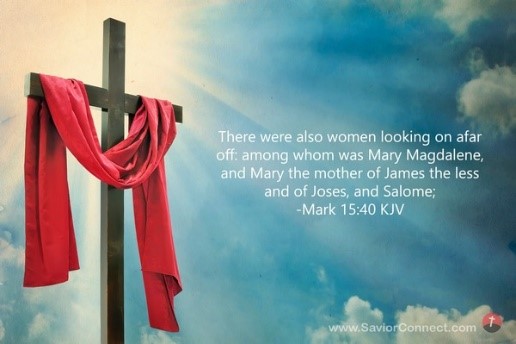
There is a tradition in African American communities called tarrying. It is when friends, family, and church family gather around the body of someone who is sick and sometimes near death—and the community begins to sing and sometimes pray with the hopes that the one who is infirmed might be restored or received with open arms by a loving and redeeming God. Can you imagine Mary Magdalene, Mary the mother of James, and Salome watching from afar as Jesus died on the cross and not really knowing what to do, not knowing if they could cry out, not knowing what song to sing to bring him comfort at his most painful hour?

Tarrying is not simply about bringing comfort to the one who is sick or dying; it is a willingness to enter into the pain of the community. These women dealt with their grief together. They probably wiped each other’s tears and held each other’s hands. They knew they could not change the fact that their Lord had died but, they could commit to not suffering alone. You see, many of us are suffering in silence because we are too afraid to be vulnerable, too afraid to let our images slip. But maybe in the sharing of our pain, we might find others who are grieving too, others who are singing our songs, and praying our prayers. And maybe as we find our collective voice of pain, we can discover our collective hope of resurrection.

PRAYER:

This prayer is an ancient collect from the 6th century.

O God of unchangeable power and eternal light, look favorably on your whole Church, which is a wonderful and sacred mystery. In your eternal foreknowledge, you peacefully do your saving work for humanity. Let the whole world know that things that were cast down are being raised up, and things that had grown old are being made new, and all things are being restored by him in whom they have their beginning, Jesus Christ our Lord. Amen.

MUSIC MEDITATION:

The Old Rugged Cross  Performed by The Martin Brothers

The hymn was written in 1912 by George Bennard, an evangelist traveling throughout the Midwest. He was heckled incessantly by several youth at a revival meeting in Michigan. Troubled by their disregard for the gospel, Bennard turned to Scripture to reflect on the work of Christ on the cross and wrote this hymn.

Read Full Post »

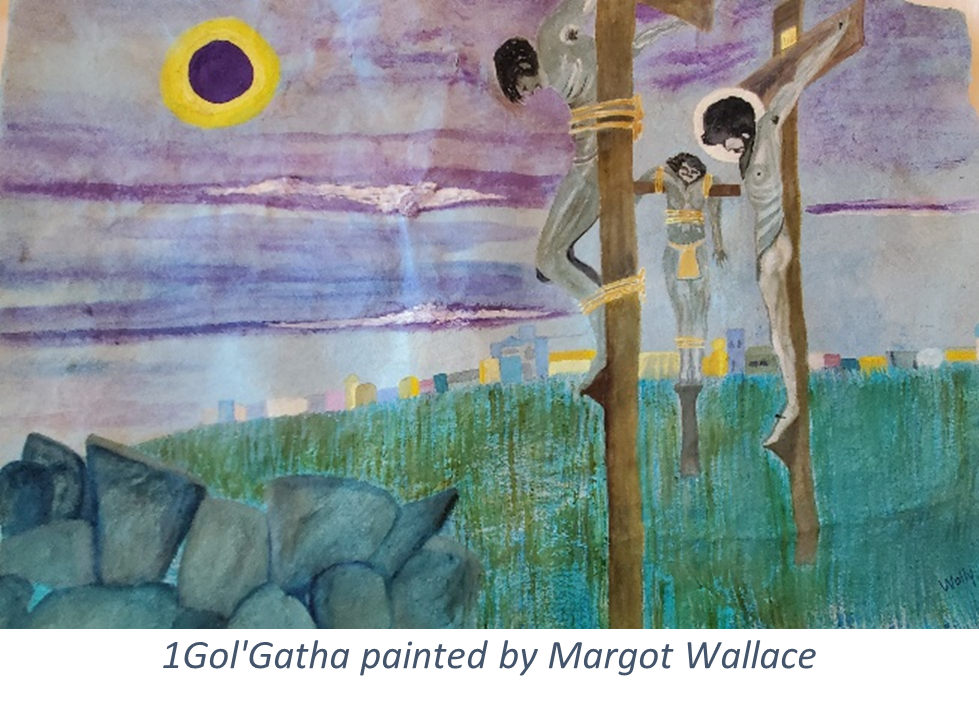
Gol’Gatha

MEDITATION:

Written by Margot Wallace

Gol ‘Gatha is not the place where anyone, especially a king, wants to end their life.  It was the most demeaning, brutal, Roman punishment rendered to their State’s most feared political adversaries – to hang humiliated in public view for days until death. The ways of kingship understood in Judah are based on the divine sayings by which God, through the prophets, bestows office.  Whoever sat at the right hand of a King on formal occasions was next to him in rank and identified as the official empowered to represent the king and carry out his policy. The King was the principal mediator between God and people.  Melchizedek, the ancient predecessor of the Davidic line in the kingship of Salem (old name for Jerusalem), was such a king. His name means “King of Righteousness” or Salem(peace), later known as Jerusalem.  There is no mention of his birth or death, however, this King is known by Abraham, combining the functions of king and priest (Genesis 13-14). 

Jesus Christ, through his submission to the Roman death on a cross, becomes the anticipated (Psalm 72) Messianic King – High Priest after the order of Melchizedek (Hebrews 5-7). He sits at the right hand of God (Psalm 110), in anticipation of the Last Judgment that will take place at the end of time (Revelations). Holding his position eternally by overcoming death, he lives to intercede for us, who wish to draw near to God now. Through the power of an indestructible life, this Son is appointed, who has been made perfect forever.

PRAYER:

This prayer is modified from the Mozarabic Rite, a liturgical rite of the Latin Church, once used in what is now Spain and Portugal that was developed in the 500s A.D.

O God, Son of God, you suffered for us, the righteous for the unrighteous. Save us by the shame of your Passion and clothe us with the robe of your righteousness. Through the suffering and death you did not deserve we have escaped the punishment our sins have deserved. Amen.

MUSIC MEDITATION:

Were You There When They Crucified My Lord?  Performed by Three Mo’ Tenors

This is an American Spiritual that was first printed in 1899 and included in the Episcopal Church hymnal in 1940. It was the first spiritual to ever be put in any major American hymnal.

Read Full Post »

A Passion for Justice

MEDITATION:

Written by George Young, a contemporary pastor and former missionary.

History is littered with attempts to bring about justice, to find “systems so perfect that no one will need to be good,” as T. S. Eliot once said. In the past century, revolutions in the name of perfect, just societies have massacred innocent people by the millions, bringing about unprecedented misery and massive injustices of their own. Cries for justice are sometimes so politicized by the ideology of class warfare that the jargon of justice itself is a turn-off. If the Lord himself were not passionate about justice, we would almost rather despair of even trying, live in isolation, and let the rest of the world go by.

Believers whom God has called into the realm of politics have an opportunity to “loose the chains of injustice” widely. And it is important that we pray that God will give them wisdom to tear out deep-rooted injustice. For those in other callings, justice is sometimes simpler, like giving a cup of cold water in Jesus’ name. Harder than that, though, is breaking out of our own self-centeredness and listening to the voice of compassion within, “when [we]see the naked, to clothe them, and not to turn away from [our] own flesh and blood.” Bob Dylan sings about the homeless, “What good am I … if I just turn away when I see how you’re dressed?”

PRAYER:

Written by George Young, author of today’s meditation.

We look up to you, Lord Jesus, the just Judge of all. Search our hearts, that we may be a part of the solution, not the root of the problem. Amen.

MUSIC MEDITATION:

Where Charity and Love Prevail:  Performed by Walk With Faith

This Latin hymn, Ubi Caritas, is from the 9th century. It was translated and published in 1961 by Omer Westendorf (1916-1997).  It is traditionally performed on Maundy Thursday.

Read Full Post »

« Newer Posts - Older Posts »