Feeds:
Posts
Comments

Archive for the ‘Religion’ Category

Sowing and Reaping

MEDITATION:

Written by Aaron D’Anthony Brown, a contemporary writer, teacher, and visual artist.

One of the most frustrating parts about being a Christian is watching others be applauded for wrongdoing while we feel ignored for doing good. Sometimes we feel this at work, in the classroom, or even on the dating scene. If we’re good people, why aren’t we recognized? Are we not as good as we think? Maybe, and that’s always something to consider, though the issue could be a matter of perspective. Are we seeking the admiration of others and some sort of prize, or are we content with having God’s approval? Sowing and reaping are not always as simple as two plus two. Sometimes we get what we deserve, sometimes not. One thing’s for certain, however, “we will reap at the proper time if we don’t give up.” That could be tomorrow, years down the road, or in the next life.  As Christians, we want to ensure that what we reap is good. But what exactly are sowing and reaping? In the spiritual context, sowing is to do something, and reaping is to receive the consequence of that action. Think cause and effect. Christians are tasked with sowing and reaping fruits of the Spirit: kindness, faithfulness, gentleness, and more. Therefore, we sow through every word and every deed every single day. Scripture speaks to believers, though, everyone participates in sowing and reaping, whether we are Christian or not, and whether we believe in God or not. The question is, what are we sowing, and what are we reaping? This is something to consider in all areas of our lives and in all of our relationships. … This brings us back to an earlier question – are we seeking the admiration of others and some sort of prize, or are we content with having God’s approval? Ideally, Christians sow because of a desire to serve God and others, not for selfish vainglory. We find contentment in sowing regardless of what acknowledgment we receive. By sowing to the Spirit, we perform good deeds with the hope of receiving positive results. This idea of sowing and reaping is especially important because Jesus commands us to abide in Him. He calls Himself the vine, and we are the vine’s branches. We reveal our faith when we produce fruit. The only way to produce fruit is to sow. Do we always get what we deserve? No.  We may think we want the answer to be always, but when we consider ourselves flawed and sinful, we likely reconsider. If we always got what we deserved surely, there would be plenty of good things that resulted from our good deeds, but there would also be plenty of consequences that result from our daily sins. That’s why God commands us to avoid sin and do good things. Good deeds produce good fruit. Not always immediately. Not always in the way that we expect. Not always for our own enjoyment, but blessings do result from following Christ. In due season, we reap what we sow.

PRAYER:

Written by E. A. Adeboye, a contemporary pastor and author.

Father,  thank You for the secret of sowing and reaping which Your Word has revealed to us! Thank You because every seed we sow we sow as Stewards of the Lord! We Trust and obey You for how and where to sow!  Amen.

Read Full Post »

Morning Grace

MEDITATION:

Written by Frederic William Farrar (1831-1903), an English cleric, schoolteacher, and author.

My mother’s habit was every day, immediately after breakfast, to withdraw for an hour to her own room, and to spend that hour in reading the Bible, in meditation, and prayer. From that hour, as from a pure fountain, she drew the strength and sweetness which enabled her to fulfill all her duties and to remain unruffled by the worries and pettinesses which are so often the trial of narrow neighborhoods. As I think of her life, and all it had to bear, I see the absolute triumph of Christian grace in the lovely ideal of a Christian lady. I never saw her temper disturbed; I never heard her speak one word of anger, of calumny, or of idle gossip; I never observed in her any sign of a single sentiment unbecoming to a soul which had drunk of the river of the water of life, and which had fed upon manna in the barren wilderness. 

PRAYER:

Written by Joseph Parker (1830-1902), an English minister and theologian.

My Father, I am coming. Nothing on the mean plain shall keep me away from the holy heights. At Thy bidding I come, so Thou wilt meet me. Morning on the mount! It will make me strong and glad all the rest of the day so well begun.

Read Full Post »

How God’s Grace Works

MEDITATION:

Written byGary Abud, Jr., a contemporary educator and teacher.  This is excerpted from his article “God Pursued Me and Transformed Every Part of My Life.”

I am a double cornea transplant recipient, which stemmed from a childhood eye disease that took my sight in my late teens. And to get a cornea transplant, someone had to die so they could donate their eye tissue—it was something I couldn’t have done myself. It was a gift I did nothing to earn, and one I could not repay to the family members of my donor. Quite literally someone had to lose their son in order that I could have my sight back. Reading about the life and death of the Son of God in Jesus the King prompted me to look back on my eye surgery and recognize exactly how God’s grace worked and what Jesus did for me in a very personal way. 

PRAYER:

Written by Dominic of Osma (1170-1221), a Castilian priest and founder of the Dominican order.


May God the Father who made us bless us.

May God the Son send his healing among us.

May God the Holy Spirit move within us and

give us eyes to see with, and ears to hear with,

and hands that your work might be done.

May we walk and preach the word of God to all.

May the angel of peace watch over us and lead us at last by God’s grace to the Kingdom.  Amen.

Read Full Post »

Fruit That Abounds

MEDITATION:

Written by Os Hillman, a contemporary speaker, author, and consultant on faith at work.

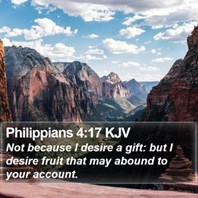
The apostle Paul had a tent-making business. However, over time, it was evident that more and more of his time was being given to vocational ministry activities. That required him to receive income from those to whom he invested his life. It became increasingly difficult to run a business and travel and minister. His letter to the Philippians (Philippians 4:14-19) gives us a perspective on giving. Although Paul appreciated the support financially, his real joy came in the fact that their gift was being credited to their Heavenly account. Paul had a confidence that God would always provide what he needed. Sometimes it came from his business. Sometimes it came through others. He was not overly concerned with where his provision would come from. His confidence was in God, his provider. So, his attitude was in affirming the benefit that came to the giver from a Kingdom perspective. Paul learned that it wasn’t a church or a business that was his provider. It was God. These were merely tools God used to support him.

PRAYER:

Written by John Birch, a contemporary author on Celtic and other prayer.

Bless the givers,

eyes open

for those in need

of prayer,

encouragement,

support,

a little time,

the gift of love.

In the act of giving

and receiving

may both be blessed. Amen.

Read Full Post »

Degrees of Faith

MEDITATION:

Written by L.B. Cowman (1870-1960), an American author.

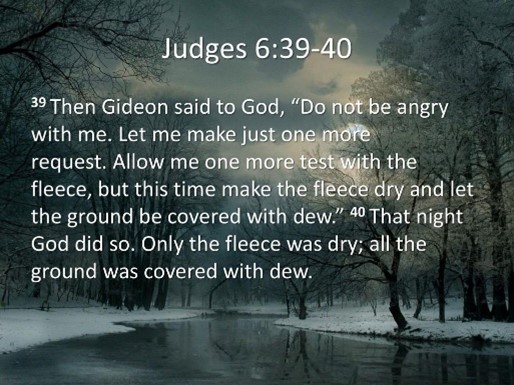
There are degrees to faith. At one stage of Christian experience, we cannot believe unless we have some sign or some great manifestation of feeling. We feel our fleece, like Gideon, and if it is wet we are willing to trust God. This may be true faith, but it is imperfect. It always looks for feeling or some token besides the Word of God. It marks quite an advance in faith when we trust God without feelings. It is blessed to believe without having any emotion. There is a third stage of faith which even transcends that of Gideon and his fleece. The first phase of faith believes when there are favorable emotions, the second believes when there is the absence of feeling, but this third form of faith believes God and His Word when circumstances, emotions, appearances, people, and human reason all urge to the contrary. Paul exercised this faith in Acts 27:20, 25, “And when neither sun nor stars in many days appeared, and no small tempest lay on us, all hope that we should be saved was then taken away.” Notwithstanding all this Paul said, “Wherefore, sirs, be of good cheer; for I believe God, that it shall be even as it was told me.” May God give us faith to fully trust His Word though everything else witness the other way.

PRAYER:

Written by Rachel Dawson, a contemporary writer.

 Dear God, thank you that you’ve carried us through the uncertainty of deep waters, through the flames of trials, and through the pain of hard losses. We are constantly aware of how much we need you, your grace, your strength, your power working through even the toughest days. Help us to keep our focus first on you this season. Please forgive us for giving too much time and attention to other things, for looking to other people before coming to you first. Help us to reflect again, on you. Thank you that you came to give new life, peace, hope, and joy. Thank you that your power is made perfect in our weakness. Help us to remember that the gift of Christ, Immanuel, is our greatest treasure. Fill us with your joy and the peace of your Spirit. Direct our hearts and minds towards you. Thank you for your reminder that both in seasons of celebration and in seasons of brokenness, you’re still with us. For you never leave us. Thank you for your daily powerful Presence in our lives, that we can be assured your heart is towards us, your eyes are over us, and your ears are open to our prayers. Thank you that you surround us with favor as with a shield, and we are safe in your care. We choose to press in close to you today, and keep you first in our hearts and lives. Without you we would surely fail, but with you, there is great hope. Thank you for your healing power, thank you for bringing us into this new season up ahead. We look forward to all that You still have in store. In Jesus’ Name, Amen.

Read Full Post »

Community of Christ

MEDITATION:

Written by W. Paul Jones, a contemporary priest, professor of theology, and author. This is an excerpt from his book “The Art of Spiritual Direction.”

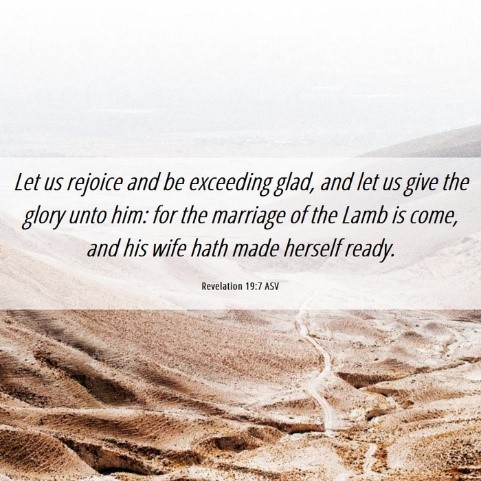
The Christian is a citizen of the Church universal. While we delight in the uniqueness of each individual, our deepest joy is to be part of the community that Christ embraces as his own body. Invited to his marriage feast yet to be, we partake of his body and blood. And at these sacred moments, it is enough just to stand around, passing the peace for which the world yearns, being the church adorned as a bride awaiting her divine Lover.

PRAYER:

Written by B. Michael Watson, Jean Hawxhurst, and Kyle R. Tau, contemporary pastors and officers of the Council of Bishops of the Methodist Church.

 Eternal Creator; immortal, invisible, God only wise: With these words, we quiet ourselves before you again with awe and reverence. We thank you for this day, a day that is new and fresh, a day we do not deserve, but a day you have given us. We praise you for your graciousness and your steadfast and generous love. We confess we have not always used the days you have given us to further your Kingdom. We have been selfish, focusing on our own needs and our own advancements. Forgive us, we pray. Free us for joyful obedience to walk in your ways and to further your love in this world. This day we thank you for our sister and brother Christians within our own faith community and throughout your world. In your creative genius, you have made all of us with different gifts to bring to your table, and your Spirit has given us the unity to appreciate and celebrate all those gifts. Thank you for that unity in the midst of beautiful, challenging diversity. Thank you for the many expressions of following your son’s Way that are making a difference around your world. Today, we pray for your universal church. We pray for our shared mission to your world. We pray for open eyes and open hearts for those who need to hear your message of grace. We pray for kindness among our faith communions, even when we disagree with each others theology or opinions. We pray for wisdom and insight to maintain unity without demanding uniformity; to celebrate our diversity instead of making it a cause for division, to claim that diversity as a part of your gracious gift to us. Grant that we may speak, and act, and live, so that the world may see in us the promise of your will, and so that the world may be challenged to move toward that vision, in and through the Christ, who is our source and our goal. Amen.

Read Full Post »

MEDITATION:

Written by Trillia Newbell, a contemporary author. This is an excerpt from her article “Learning to Abide in Christ.”

Beginning in John 13, Jesus gives a series of farewell addresses… He knows that he will soon be lifeless on a tree — the crucified King. And in the middle of it all, he graciously reminds us that to be his means to bear fruit and we bear fruit by abiding in him. The dictionary defines abiding as to accept or act in accordance with a rule, decision, or recommendation. Synonyms include obey, observe, follow, uphold, heed, and accept. This definition isn’t far off from what Jesus is telling us to do in John 15. But before he gets to the meaning, he gives us a picture of what it looks like not to abide in him. “If anyone does not abide in me, he is thrown away like a branch and withers, and the branches are gathered, thrown into the fire, and burned” (John 15:6). I guess I am what you would call a plant killer. I purchase plants and try to care for them, but I often fail miserably. I forget to water the plant, choking it from its needed nourishment. And then one day, I turn around and there it is, withered away. This didn’t happen overnight. It happened after a series of neglect. So one by one, the branches fall off from the vine… He explains that by not abiding in him we are like my pitiful plants — we will soon fall off the vine — our roots where we receive nourishment were never truly planted. The fruit of the vine is proof of our faith. Not perfection — but fruit, even if a small bud. It really isn’t until John 15:10 that we get a picture of what it looks like to abide in Jesus. “If you keep my commandments, you will abide in my love, just as I have kept my Father’s commandments and abide in his love.” To abide in Jesus means to keep his commandments and to keep his commandments means to love God with all our hearts and souls and minds and to love our neighbor as ourselves (Matthew 22:37–39). One way that we display our love for God is through our trust, prayer, and devotion to him. We abide through relationship. We pursue in love. We pray in love. We obey in love. And here is the good news: We love Jesus because he first loved us (1 John 4:19). We didn’t choose him; he chose us, and he chose us to walk out our faith in obedience to him (John 15:16). Apart from Christ, we cannot do anything (John 15:5). This is also good news to the weary person who thinks he must muster up strength to pursue and know Christ (and to love his neighbor — a fruit Jesus emphasizes). He provides the grace and the strength. The fruit that Jesus speaks of is simply evidence of a relationship with him. It is a relationship that he initiates through and by his sovereign love. In this chapter, Jesus reminds us that there is no greater love than someone laying down his life for his friends. He then says, “You are my friends if you do what I command you” (John 15:13). Jesus tells us that we are his friends (let that soak in for a minute) if we obey his command to love, and that command is fulfilled through abiding. As we abide in him, we will bear the fruit of righteousness. This does not add to our salvation by grace alone through faith alone, yet it confirms our transformed heart. And the offer to be Jesus’s friend — the author and perfecter of our faith, the Alpha and Omega, the Beautiful One, the one who bore our sins and transgression — the offer to be his friend is irresistible for the Christian. Abide in him, and he will abide in you. He who began a good work in you will complete it (Philippians 1:6). He who called you is faithful; he will surely do it (1 Thessalonians 5:24).

PRAYER:

Written by Dawn Wilson, a contemporary author and is the  director of Heart Choices Today.

Dear Lord, Help me remember you are indeed Lord of my life. You have the right to rule all that I think, believe and do. When I allow my mind to run to places that destroy my peace, remind me that You do not want me to dwell on thoughts and emotions that contribute to unreasonable fears. I know my mind will remain in perfect peace as I fix my thoughts on you; so Lord Jesus, let your peace rule in my heart. Remind me of the peace I have in your family, and teach me how to be thankful for those circumstances that cause me to run to you, focus on you, and abide in you. I never need live with fearful, anxious thoughts. The truth is, you are in control! Amen.

Read Full Post »

Christian Fellowship

MEDITATION:

Written by Dietrich Bonhoeffer (1906-1945), a German pastor, theologian, author, anti-Nazi dissident and founding member of the Confessing Church. This is an excerpt from his book “Life Together.”

If we do not give thanks daily for the Christian fellowship in which we have been placed, even where there is no great experience, no discoverable riches, but much weakness, small faith, and difficulty; if on the contrary, we only keep complaining to God that everything is so paltry and petty, so far from what we expected, then we hinder God from letting our fellowship grow according to the measure and riches which are there for us all in Jesus Christ.

PRAYER:

Written by Meg Bucher, a contemporary writer and teacher.

Father in Heaven, Abba, Yahweh, who delights in His children. Jesus, Messiah, who calls us friends. Holy Spirit, gift from above and constant companion. Glory be to the One True, Triune, God! You know when we are lost, Lord. You found us, heaped in our own motivations and confused by worldly principles. You rescued us, defeating death on the cross and rising to sit at the right hand of the Father in heaven. Your reach into our everyday lives, our messy circumstances, forever changes us. Not one day of our lives is more or less important. No one person more or less loved. In Your perfect way, You hold the world in balance and our souls in tune. You hear every voice, every prayer, every cry, and every shout of praise, simultaneously and always! Your ways are not our ways, but oh, God… please lead us in Your purpose for our lives. Let Your glory, Light, and Living Water flow from our lives. May all who know us feel the love You have for all …and the care in which You save the lost. Jesus, in Your Powerful Name we pray, Amen.

Read Full Post »

Intense Fire

MEDITATION:

Written by Cortland Myers (1864-1941), a pastor and author.

The finest china in the world is burned at least three times, some of it more than three times. Dresden china is always burned three times. Why does it go through that intense fire? Once ought to be enough; twice ought to be enough. No, three times are necessary to burn that china so that the gold and the crimson are brought out more beautiful and then fastened there to stay. We are fashioned after the same principle in human life. Our trials are burned into us once, twice, thrice; and by God’s grace these beautiful colors are there, and they are there to stay forever.

PRAYER:

Written by Brennan Manning (1934-2013), American author, laicized priest, and public speaker. This is an excerpt from this book “Reflections for Ragamuffins.”

What the world longs for from the Christian religion is the witness of men and women daring enough to be different, humble enough to make mistakes, wild enough to be burned in the fire of love, real enough to make others see how unreal they are. Jesus, son of the living God, anoint us with fire this day. Let your Word not shine in our hearts, but let it burn. Let there be no division, compromise, or holding back. Separate the mystics from the romantics, and goad us to that dare-devil leap into the abyss of your love.

Read Full Post »

The Blessed

MEDITATION:

Written by Jonathan Petersen, contemporary writer and content manager for Bible Gateway.

On a hillside, possibly in the Korazim Plateau in northern Israel near the Sea of Galilee, Jesus began his Sermon on the Mount—the term first used by the 4th/5th century theologian, Augustine—with a grouping of virtues we know as the Beatitudes, in which he repeatedly emphasized the Greek word makarios, meaning “blessed (receiving God’s favor), fortunate, good (in a position of favor), happy (feelings associated with receiving God’s favor) … Makarios is a state of existence in relationship to God in which a person is ‘blessed’ from God’s perspective even when he or she doesn’t feel happy or isn’t presently experiencing good fortune. Negative feelings, absence of feelings, or adverse conditions cannot take away the blessedness of those who exist in relationship with God…Dr. Tony Evans calls the Sermon on the Mount Jesus’ kingdom manifesto. He says, “We could call the Beatitudes antibiotics from God’s pharmacy that can aid life transformation. They are a reminder that Jesus is primarily concerned with what’s happening on your inside, which should be the basis of what you’re showing on the outside.” The beatitudes are blessings Jesus pronounced on the most unlikely of people—the poor, the hungry, the meek—as the kingdom of God was arriving in his ministry. The opposite of curses, blessings are the bestowment of favor, mercy, and protection upon a person, resulting in that person’s happiness and feelings of joy, satisfaction, contentment, and fulfillment…The Beatitudes describe the blessedness of those who have certain qualities or experiences that identify people belonging to the kingdom of heaven. “In the Beatitudes Jesus announces that God’s values are often radically different from the world’s. God will bless those who pursue the ethics of his kingdom and choose to put him first over the things of this world…We must recognize that the sermon is directed to the disciples and through them to the whole church today. The sermon addresses both inward motives and outward conduct. These legitimate demands are so strict that no one can completely obey them, and we are therefore driven to the grace and mercy of God. In some cases Jesus uses obviously intentional exaggeration to illustrate the absolute requirements of God’s law…The kingdom of God “belongs to those who know they have no resources, material or spiritual, to help themselves before God. These are the “poor” to whom Jesus has come to announce “good news” and to whom the kingdom of heaven belongs. Jesus teaches that the norm of the kingdom of heaven is spiritual bankruptcy, unlike the spiritual self-sufficiency that was characteristic of the religious leaders. Jesus’ disciples will experience their most complete personal fulfillment as they draw on the resources of the kingdom of heaven to guide their lives. Character is the identity of who we are, but conduct is what we do… Character comes first and conduct flows from it. Behavior follows belief. The Beatitudes display the beauty of kingdom life.

PRAYER:

Written by Paul Carr, a contemporary British minister and writer.

Gracious God, you have so richly blessed us with life,
with love and joy, with hope in the midst of despair.
Help us to be the salt of the earth. Help us to be the light of the world, sharing with others that which we have received, boldly proclaiming the good news of your love, finding the seeds of your kingdom within us and letting your way grow in our lives and throughout the world. Amen.

Read Full Post »

« Newer Posts - Older Posts »