Feeds:
Posts
Comments

Archive for the ‘Religion’ Category

Today’s devotional is an excerpt from Guidepost’s devotional “Held in Perfect Peace.”

For the first time in months, I awoke before my alarm. The temperature had dropped. Good morning, Lord. I love You, I said silently. Then I went to make coffee. I smiled as I walked into the kitchen of our new apartment. It is a separate room, not the mere three-foot-long stretch of counter adjacent to the living/dining area in our old place. I luxuriated in it, thankful, as I poured hot water into the French press and stirred the ground coffee with a chopstick. Then I padded across the new blue carpet to my chair in the living room. Early-morning sun glinted off the bricks of the apartment building across the street. Sparrows twittered somewhere. Life felt good.

I sipped my coffee and chuckled. Absolutely nothing was different that morning except the temperature and a good night’s sleep. Every problem I’d had the day before still existed. One of my kids was in the hospital after a suicide attempt. Another was struggling mightily with the stress of the situation. Our prior landlord refused to return my calls to negotiate an end to our lease. Many things in my life were not good, yet I was feeling reasonably content. I prayed (wryly): “You were right, Lord. Feeling helpless doesn’t mean everything is hopeless.” Fortunately, when I stress because I can’t imagine a way out of a bad situation, God gently corrects my thoughts: “Right now, I can’t see the way. Perhaps tomorrow I will. I may wake up, smell the coffee, and see the light, and what felt impossible will feel more doable.” I can’t always imagine that possibility. What I can do, though, is pray.

Prayer:

This prayer is written by Joni Eareckson Tada, a contemporary author.

Lord, expand my vision today. Let me see the light of day from Your perspective. Drive home the tent pegs of hope deep and far. Stretch my life to conform to the potential You see.

Read Full Post »

Written by Clarence L. Haynes, Jr., a contemporary public speaker, ministry leader, and writer.  

We have a young daughter who is still getting used to sleeping in her own bed in her own room. I feel it is taking much longer for this to happen, but maybe that is a conversation for another time. Recently she came into our bedroom, and she said she couldn’t fall asleep because she was afraid. We had just prayed before she went to bed, and yet she said she was still afraid. I encouraged her it was going to be okay and she could go back to her room. To this, she responded, “Could you at least stay with me until I fall asleep?” I thought that was a reasonable request, so I went into her room and sat with her until she fell asleep. The comfort in her knowing I was there, watching over her, and being able to protect her if something happened allowed her to fall asleep quickly and rest easily. As I thought about her request, it reminded me of Psalm 121:4. We have a God in heaven who never sleeps nor slumbers. If we are going to have full disclosure, we are more like my daughter than we sometimes want to admit. Even after praying, we can still find ourselves afraid, anxious, or worried. Many times, this results from not knowing what will happen or how things are going to work out. It is in these moments we need to do like my daughter did. What she desired was the comfort of my presence, and because she knew I was there, it changed her mind set and gave her peace. This is exactly what we must do.

Prayer:

This prayer is from the “Carmina Gadelica,” from the Gaelic regions of Scotland.

I lie down this night with God,

And God will lie down with me ;

I lie down this night with Christ,

And Christ will lie down with me ;

I lie down this night with Spirit,

And the Spirit will lie down with me

God and Christ and the Spirit

Be lying down with me.

Read Full Post »

Written by Richard Foster, a contemporary Christian theologian and author. This is an excerpt from his book “Learning Humility.”

Authentic Christian community is shaped by virtues that the world cannot grasp. And humility in particular is central for such community life to function. This is especially critical for today when we are witnessing a shrinking moral vocabulary in public life. These thoughts draw me to Dallas Willard’s final work, “The Disappearance of Moral Knowledge.” Are we slipping into a dark age? I’m not sure. Regardless, one contribution we can make in these dark days is to create new expressions of Christian community life where a rich moral vocabulary can be preserved. Even more, we want to take such a vocabulary and incarnate it into the push and shove of daily life.

Prayer:

Written by Mark D. Roberts, a contemporary author and speaker.

Gracious God, thank you for the example of Jesus. Thank you for how he called the twelve to be with him in a special way, to share in life and work together.

Thank you, Lord, for calling me into relationship with you and into your ministry. Help me to “be with you” even as your first disciples were with you. By your grace, may I discover how to know you better as I live my life in relationship with you.

Read Full Post »

Written by Ken Boa, a contemporary teacher, writer, and speaker and president of Reflections Ministry.  This is an excerpt from his work “How to Be a Hopeful Realist.”

In its healthy expressions, desire is the impetus for change and transformation. It’s the force that helps us to drag our weary limbs to the gym every morning, or to have a loving confrontation in the hopes of restoring a relationship. Notice that in both of these cases the wish must outstrip the lower desire of comfort and ease. It’s easier to hit the snooze button and roll back over. It’s easier to sweep tensions under the rug and allow faltering relationships to die a slow death. Both examples present us with a need for bigger, rather than smaller wishes. We wouldn’t tell the person pursuing a healthier lifestyle to face reality by quitting the gym because of its threat to superficial comfort levels. Nor would we counsel someone seeking to mend a broken friendship that the difficulty entailed by such an undertaking is just too great. Poor health and estrangement are not more realistic options. As C.S. Lewis observed so well, it’s not that our Lord finds our desires excessive, but rather that he finds them too meager. “We are far too easily pleased.” One of the great tragedies that befalls so many Christians is that they misplace their hopes in the kingdom of this world and then become afraid to wish for more. In their disappointment and dismay, they settle for the small comforts of money, power, fame, or a Hallmark Christmas movie and a glass of wine. In each of these cases, the ceiling of hope has been drastically lowered. This is not a description of realism, but one of chronic spiritual immaturity. If we want to be both hopeful and realistic, we must allow Christ to transform our wishes—to make them infinitely larger and more capacious, so that we can eagerly await His return to wipe away every tear and to make all things new. 

Prayer:

Today’s prayer is from the Book of Common Prayer used by the Anglican church.

O God, whose glory it is always to have mercy: Be gracious to all who have gone astray from thy ways, and bring them again with penitent hearts and steadfast faith to embrace and hold fast the unchangeable truth of thy Word, Jesus Christ thy Son; who with thee and the Holy Spirit liveth and reigneth, one God, forever and ever. Amen.

Read Full Post »

Written by Anne Graham Lotz, a contemporary American evangelist and daughter of Billy Graham.  This is an excerpt from her book “On Wings of Faith.”

I understand that a turkey and an eagle react differently to the threat of a storm. A turkey reacts by running under the barn, hoping the storm won’t come near. On the other hand, an eagle leaves the security of its nest and spreads its wings to ride the air currents of the approaching storm, knowing they will carry it higher in the sky than it could soar on its own. Based on your reaction to the storms of life, which are you? A turkey or an eagle? It’s natural for me to be a turkey in my emotions, but I have chosen to be an eagle in my spirit. And as I have spread my wings of faith to embrace the ‘Wind’, placing my trust in Jesus and Jesus alone, I have experienced quiet, “everyday” miracles: His joy has balanced my pain. His power has lifted my burden. His peace has calmed my worries. So . . . would you spread your wings of faith and soar?!

Prayer:

Written by an unknown author.

May you be wrapped up in God’s love. Found deep in his everlasting wings. Carried and kept, safe and cherished. May the healing power of Christ breathe across your being now. Amen.

Read Full Post »

Written by Art Schoonveld, a contemporary retired pastor.

Yesterday Christians everywhere celebrated the resurrection of the Lord Jesus. Some of us sang the words, “I serve a risen Savior, he’s in the world today.” And our hearts resonated with every word. Today we’re back to school or work or at home facing the pressures of everyday life. But the risen Savior may not seem nearly as close today, and little may seem to have changed. We’re still faced with that lingering disease, that broken relationship, those financial problems, or those hardships that come with growing older. We hear about poverty and persecution, about war and conflict in so many countries, and we might ask, “Has Easter really made a difference? Has anything changed in the past 2,000 years since Jesus’ resurrection? Are things any better in the 21st century than they were in the first century?” Though nations, technology, and social institutions have changed a lot since then, the human condition is much the same. God’s image bearers are still addicted to sin. Jesus warned his followers, “In this world you will have trouble.” But because he has overcome the world, we can have new life in him and peace in spite of our struggles. We can strive to enact God’s restoration in our daily lives. We can share his love with others and look forward together to the day when the risen Savior will return!

Prayer:

Written by Art Schoonveld, author of today’s meditation.

Lord Jesus, help us to trust that you have overcome the world and will come again, making all things new. Amen.

Read Full Post »

Written by Laurie Zuverink, a contemporary pastor.

Life on this earth is not without dark times. We can identify periods in history when evil and darkness seemed to be in control. We can look back on our own lives and recall times of grief, hurt, loneliness, or despair. Or maybe those times are happening right now, and life seems empty of meaning or purpose. Maybe all of life seems like a dark, empty space. Jesus knows what that’s like—and even more. On the cross he suffered the agony of complete separation from God (descending into hell) so that we wouldn’t have to—and his body was placed in a tomb till he rose to life again on the third day. Jesus’ work of salvation for us would not have been complete if he did not suffer the full punishment of “unspeakable anguish, pain, and terror of soul” on the cross to pay the price for all our sins (Heidelberg Catechism, Q&A 44). And on Easter he rose in victory over death so that we might share in the power of his resurrection and enjoy new life with God. Our journey into new life in Christ may take us through times of darkness. Yet, as hard as those times may be, we can be assured that death, loneliness, and despair do not have the final victory; Jesus conquered them. As you walk through valleys of shadow in your life, lean on Jesus, the Savior—who knows you and is walking with you into new life.

Prayer:

Written by Laurie Zuverink, author of today’s meditation.

God of new life, assure us of your presence, especially when darkness and despair seem all around. In Christ we pray. Amen.

Read Full Post »

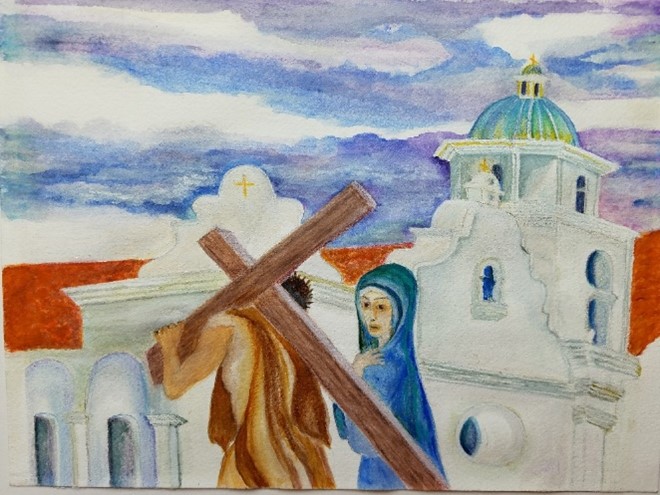
Written by Margot Wallace from the Village Church.  Margo also painted the pictures associated with the meditation:  “Jesus Meets His Mother,” and “Gol’gatha, King of the Jews.”

Here is my view of the Ultimate Exile: The images below exemplify Jesus’ crucifixion as a vivid reminder of the ultimate emotional and spiritual exile he endured. His family, community, religious colleagues, and government stood by witnessing his enforced separation. He struggled in the Garden of Gethsemane, while many thought he could and should be able to overcome this fatal sentence. But his transformation required total immersion into the next phase of his calling. By pushing through his fear, Jesus was able to put aside attachments to worldly matters and walk on humbly with God. He was redeemed to become our Redeemer.

Prayer:

Written by Alexis Wald, a contemporary pastor and writer.

God, You bring light, life, hope, and healing to all who seek You. You are what propels me forward. Not what others say or think of me, but what You say of me. I am a redeemed creation in You because of what you did 2,000 years ago. You are restoring me into your image and that Lord is what gives me strength, purpose, and drive. I am fueled by You and only You. Amen.

Jesus Meets His Mother – Painted by Margot Wallace

Gol’gatha, King of the Jews – Painted by Margot Wallace

Read Full Post »

Exile and Return

Written by Reggie Kidd, a contemporary pastor, professor, and author. This is an excerpt from the book “Exile and Return.”

The Bible’s quintessential account of “exile and return” is Jesus Christ’s death and resurrection. Matthew’s gospel portrays Jesus’s death and resurrection as the fulfillment of Isaiah’s vision of God “bringing justice to victory” through his Servant. God’s Servant will suffer in his people’s place to bear their iniquities and justify many. By his rising, Jesus, as God’s servant, will fortify “bruised reeds” and rekindle “smoldering wicks.”  The victory of justice through Jesus’s exile into death and his return from the grave will be so complete that his victory will include Gentiles as well as Jews. For this reason, Jesus insists that people not trumpet his miracles and identity during his earthly ministry. He is not on a tour of self-promotion. Rather, his mission is one of “exile and return” that he might “bring justice to the Gentiles.

Prayer:

Written by Desmond Tutu (1931-2021), a South African social rights activist and retired Anglican bishop who actively opposed apartheid in the 1980s.

Goodness is stronger than evil.

Love is stronger than hate.

Light is stronger than darkness.

Life is stronger than death.

Victory is ours through Him who loves us.

Read Full Post »

Written by Caleb Mathis, a contemporary pastor and writer. This is an excerpt from his work “Daniel: Keys to Surviving the Exile You Don’t Know You’re In.”

Even if you don’t feel like it, if you’re a follower of Jesus, you’re an exile. It’s important to recognize that fact, or you’ll be spinning your wheels in the wrong direction. When followers of Jesus are more formed by their political ideology than their theology, we’ve forgotten we’re exiles. When comfort matters more than conformity to Christ, we’ve lost the plot. When individual freedoms eclipse love of neighbor; when we’re more familiar with the numbers in our bank account than the chapter and verse of the scriptures; when we look and act and think and inhabit the world just like everyone else, we’ve not only forgotten we’re exiles, we’ve been assimilated. The dominant culture has won. The people of God have always been minority populations in the world—and they didn’t seek to be anything else. That minority population toppled the Roman Empire not by force, politics, or violence, but simply by being different. In a highly classed society, the Church treated prince and pauper alike. With hunger and sickness rampaging, the Church emptied itself to feed, clothe, and bandage the forgotten. When sexual relationships had no boundaries, the Church practiced minority sexual ethics. When the world said Caesar was Lord, the Church responded by saying that was Jesus’ title, and then they actually lived like it was true. Perhaps more than anyone else in the scriptures, Daniel understood exile—physical and spiritual. He not only survived his time of exile, he thrived under it. More than ever, we need his example… As much as I love Daniel, he puts me between a rock and a hard place. He leaves me with a choice. I can invest in the comfort of my life here and now: better job, bigger car, greener lawn— or I can humbly accept my life as an exile, a citizen of a coming-but-not-yet-realized Kingdom built on foundations of love and grace, mercy and sacrifice, that our culture will never, ever understand. I can build my life, or I can build something larger and more lasting. What I’m pretty sure I can’t do, though, is build both. Faithful people do faithful things, right? Daniel pushes me to get moving by making peace with being different, leaning on others, becoming a self-feeder, doing good work, and elevating my vision beyond myself. It’s the only way to survive, even thrive, in this exile.

Prayer:

Written by Henry Martyn (1781-1812), an Anglican priest and missionary to the peoples of India and Persia.

O Send thy Light and Thy Truth, that we may live always near to Thee, our God. Let us feel Thy love, that we may be as it were already in heaven, that we may do all our work as the angels do theirs. Let us be ready for every work, be ready to go out or come in, to stay or to depart, just as Thou shalt appoint. Lord, let us have no will of our own, or consider our true happiness as depending in the slightest degree on anything that can befall us outwardly, but as consisting altogether in conformity to Thy will, through Jesus Christ our Lord. Amen.

Read Full Post »

« Newer Posts - Older Posts »